
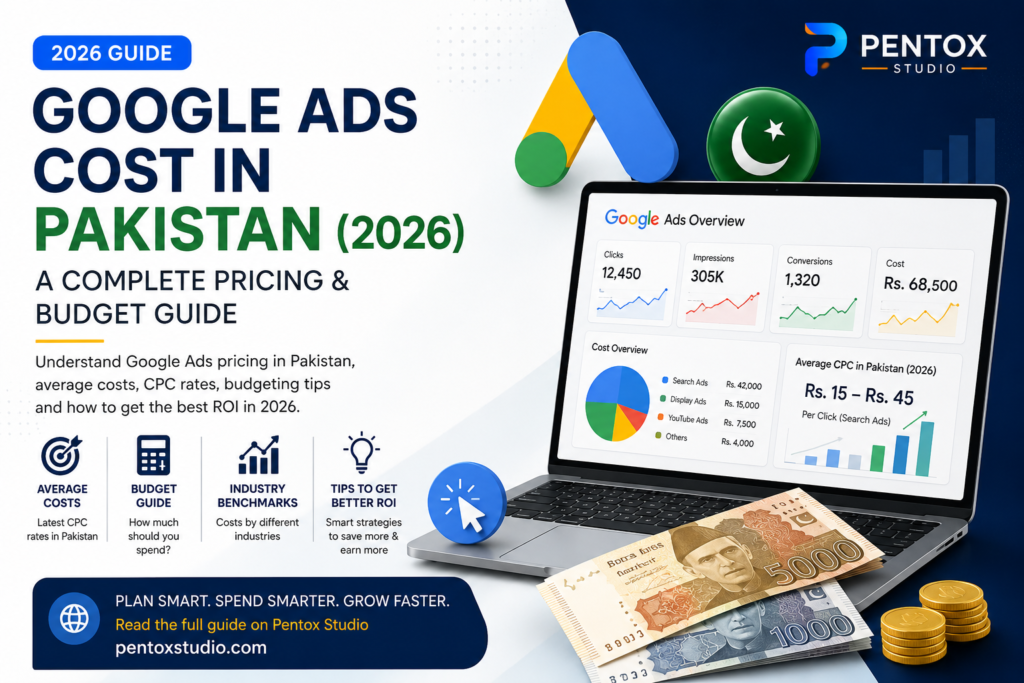
If you’re a business owner in Pakistan weighing whether to run Google Ads, the question that actually matters isn’t “what’s the average cost per click” — it’s “what will this cost me, and is it worth it.” The honest answer is that it depends heavily on your industry, your city, and whether you’re running the account yourself or paying someone to manage it. This guide breaks down both halves of that cost — what you pay Google, and what you pay an agency or freelancer — so you can budget with real numbers instead of guesswork.
How Much Does Google Ads Cost in Pakistan?
Google Ads runs on a pay-per-click (PPC) model — you only pay when someone actually clicks your ad, not for how many people see it. Every time someone searches, your ad enters a real-time auction against other advertisers targeting the same keyword. The price you pay per click is decided in that auction, and it’s shaped by two things: how much you and your competitors are willing to bid, and how relevant Google judges your ad and landing page to be.
Global benchmark data gives a useful starting point. WordStream’s 2026 search advertising report, based on more than 13,000 campaigns tracked between April 2025 and March 2026, puts the average cost per click across all industries at around $2.96 on the Search network, with costs ranging from about $1.16 for ecommerce up to $6.75 for legal services — a reminder that “average CPC” varies enormously by what you’re selling.
Pakistan’s market looks different in absolute terms, even though the mechanics are identical. Reports from agencies actively managing Pakistani accounts commonly cite average CPCs somewhere in the Rs. 20 to Rs. 200 range for most local service businesses, climbing toward Rs. 300–800 for the most competitive sectors. Treat these as industry-reported ranges rather than fixed prices — your actual CPC depends on your specific keywords and competition, and it’s worth confirming inside your own Google Ads account rather than assuming a number from any guide, including this one.
Average CPC by Industry
A few patterns show up consistently across both global and Pakistan-specific reporting:
- Real estate, legal services, and education tend to sit at the higher end — more advertisers bidding on the same keywords pushes the price up.
- Local services like electricians, clinics, and home repair typically fall in the middle.
- Ecommerce and retail keywords are usually the cheapest per click, though ecommerce accounts often need more clicks to get one sale, so cost-per-click alone doesn’t tell the whole story.
Minimum Budget to Get Started
There’s no official minimum Google requires — you could technically run a campaign on a few thousand rupees a day. But a budget too small to gather meaningful data won’t tell you much. A workable rule of thumb: your daily budget should be enough to generate at least 5–10 clicks a day, so the account has enough activity for Google’s system — and you — to judge what’s actually working. If your average CPC in your industry is around Rs. 100, that means a daily budget of roughly Rs. 500–1,000 as a realistic floor, not a guarantee of results.
It’s also worth understanding how CPC and total monthly cost relate to each other, since the two are easy to confuse. Your CPC is the price of a single click. Your total monthly ad spend is that CPC multiplied by however many clicks you’re getting, which depends on your daily budget and how much competition there is for your keywords at any given time. A business in a low-competition niche with a modest daily budget might comfortably run for a full month on what a competitive real-estate campaign in Karachi or Lahore burns through in a single week. There’s no universal “right” monthly figure — it’s a function of your specific keywords, not a flat rate that applies across industries.
What Affects Your Google Ads Cost in Pakistan
Industry & Competition
The more businesses bidding on the same keyword, the higher the price per click climbs — this is true everywhere, but it’s especially visible in crowded categories like real estate and education in major Pakistani cities, where dozens of agencies and institutes compete for the same searches.
Quality Score
Cost isn’t only about how much you’re willing to pay. Google also scores how relevant your ad and landing page are to the search — what it calls Quality Score. A well-built campaign with a modest budget can genuinely outperform a sloppy account spending three times as much, because Google rewards relevance with a lower effective cost per click and better ad placement. You can read Google’s own guidance on how this is calculated and what improves it directly from Google Ads.
Campaign Type
Search campaigns (the classic text ads that appear above organic results) tend to cost the most per click but carry the strongest buying intent. Display Network ads are typically far cheaper per click but attract a more passive audience. Performance Max campaigns blend several formats and can be efficient once there’s enough conversion data feeding the algorithm, but they usually need a few weeks and a reasonable budget before they optimize properly — not something to judge in the first few days.
Remarketing campaigns — ads shown to people who already visited your site — sit somewhere in between. They typically cost less per click than fresh Search campaigns because you’re re-engaging an audience that already knows you, and they often carry surprisingly strong conversion rates for the price, which makes them worth testing once you have enough site traffic to build a remarketing audience from.
Google Ads Management Fees: Agency vs. In-House
This is the part that gets conflated most often, so it’s worth separating clearly: the money you pay Google for clicks and the money you pay an agency to manage your account are two completely separate costs. Your ad spend goes directly from your card or bank account to Google — a properly run agency never touches that money. The management fee is a separate line item for the strategy, setup, ongoing optimization, and reporting.
Typical Agency Management Fees in Pakistan
Industry reporting from agencies operating in Pakistan generally places monthly management fees somewhere between roughly Rs. 25,000 and Rs. 90,000, scaling with account complexity and how much ad spend is being managed. Internationally, the two most common pricing models are a flat monthly retainer or a percentage of ad spend — typically in the 10–20% range — and Pakistani agencies tend to follow the same general structure, adapted to local budgets. Neither model is inherently better; the important question to ask any agency is how their fee structure incentivizes them — a straight percentage-of-spend model, for instance, only makes sense if the agency’s guidance on increasing budget is tied to actual performance, not just their own revenue.
DIY vs. Hiring Help
Running Google Ads yourself is entirely possible, and for a very small, simple account it can make sense — Google’s interface has gotten more automated over the years. Where hiring help tends to pay for itself is in three specific areas: conversion tracking set up correctly from day one (a shockingly common gap in self-managed accounts), negative keyword management to stop budget leaking to irrelevant searches, and the ongoing testing that turns a mediocre campaign into a profitable one. A cheap, unmanaged account that wastes half its budget on the wrong clicks is not actually cheaper than a properly managed one — it just looks that way on the invoice.
How to Budget as a Pakistani Business
A Small Business Budget Example
Say you run a local clinic or a small home-services business in Lahore. A realistic starting structure might look like: Rs. 30,000–60,000 per month in actual ad spend (paid to Google), plus a management fee if you’re working with an agency, depending on the scope of work. That’s enough to gather a meaningful amount of click and conversion data within 4–6 weeks — enough time to see real patterns rather than random noise from a handful of clicks.
For a larger business — say, a mid-sized ecommerce store or a multi-branch service business operating across two or three cities — the picture scales up accordingly. Ad spend in the range of Rs. 150,000–300,000 a month is common at that size, largely because more cities and more product categories mean more keywords worth bidding on simultaneously. At this scale, the management fee typically also shifts toward the percentage-of-spend model, since the account genuinely requires more day-to-day attention — more campaigns to structure, more landing pages to align, and more reporting to make sense of.
Setting Realistic ROI Expectations
The number that actually matters isn’t cost-per-click — it’s cost-per-lead, and ultimately cost-per-customer. A Rs. 40 click that never converts is more expensive than a Rs. 150 click that reliably turns into a paying customer. Before launching, work out roughly what a new customer is worth to your business, and use that to set a sensible cost-per-lead ceiling — this turns “is Google Ads expensive” into a much more useful question: “is this customer worth what I paid to get them.”
Common Google Ads Budget Mistakes to Avoid
- Judging results after a few days. Google’s system needs time and data to optimize; a week is rarely enough to draw conclusions.
- No conversion tracking. Without it, you’re optimizing blind — you’ll know what you spent but not what it actually earned you.
- Sending clicks to a generic homepage instead of a landing page that matches the ad’s promise — this hurts Quality Score and wastes clicks that would otherwise convert.
- Chasing the cheapest CPC rather than the best cost-per-customer — a cheap, irrelevant click is still money spent for nothing.
- Ignoring negative keywords, which quietly drains budget on searches that were never going to convert.
How Pentox Studio Can Help You Get More From Your Ad Spend
If you’re weighing Google Ads against other channels, it’s worth reading our comparison of Google Ads vs. SEO for Pakistani businesses to understand which fits your timeline and budget better, and our breakdown of how Google Ads compares to Facebook Ads if social platforms are also on your radar.
Whichever channel you choose, ad spend is only half the equation — improving your conversion rate on the pages your ads send traffic to is often the single highest-leverage fix available, since it lowers your effective cost-per-customer without spending an extra rupee on clicks.
At Pentox Studio, we manage Google Ads accounts for Pakistani businesses with a focus on proper conversion tracking from day one, ongoing optimization rather than “set and forget,” and transparent reporting so you always know exactly what your ad spend and management fee are each buying. If you’re deciding between running ads yourself or bringing in help, our digital marketing services team can review your account or build a campaign from scratch — and if you’re not sure Google Ads is even the right starting point, we’re happy to compare it honestly against our SEO services for your specific business and budget.
Frequently Asked Questions
Is Google Ads expensive in Pakistan?
It depends entirely on your industry and competition. Local service businesses can often start meaningfully with a modest monthly budget, while highly competitive sectors like real estate or education require more spend to compete for the same clicks. There’s no fixed “expensive” or “cheap” — it’s relative to what a converted customer is worth to your business.
What’s the difference between ad spend and management fees?
Ad spend is the money paid directly to Google for clicks — it goes straight from your account to Google’s platform. The management fee is what you pay a person or agency to build, run, and optimize the campaign. A properly run agency never has access to spend your ad budget outside the platform itself.
How much should a small business in Pakistan budget for Google Ads?
There’s no single right number — it depends on your industry’s typical CPC and how many leads you need. As a starting point, a budget sufficient to generate at least 5–10 clicks per day gives you enough activity to start seeing meaningful patterns within a few weeks.
Can I manage Google Ads myself instead of hiring an agency?
Yes, and for a very simple account it can work well. Where most self-managed accounts fall short is conversion tracking, ongoing keyword and negative-keyword management, and structured testing — these are the areas where a specialist’s time tends to pay for itself.
How long before Google Ads starts working?
Most campaigns need at least a few weeks of consistent spend and data before Google’s algorithms and your own optimization decisions have enough information to work with. Judging performance in the first few days almost always leads to premature, misleading conclusions.
Which is cheaper: Google Ads or Facebook/Meta Ads?
Neither is universally cheaper — it depends on your business and what “cheap” means to you. Google Ads generally captures people actively searching for a solution, which tends to convert at a higher rate per click even if the click itself costs more. Meta platforms often offer a lower cost per click but reach people who weren’t necessarily looking for you at that moment. The right starting point usually comes down to your sales cycle and whether your customers are more likely to search for what you sell or discover it while browsing.
Sources: WordStream 2026 Google Ads Benchmarks Report; Google Ads Quality Score guidance (ads.google.com).