
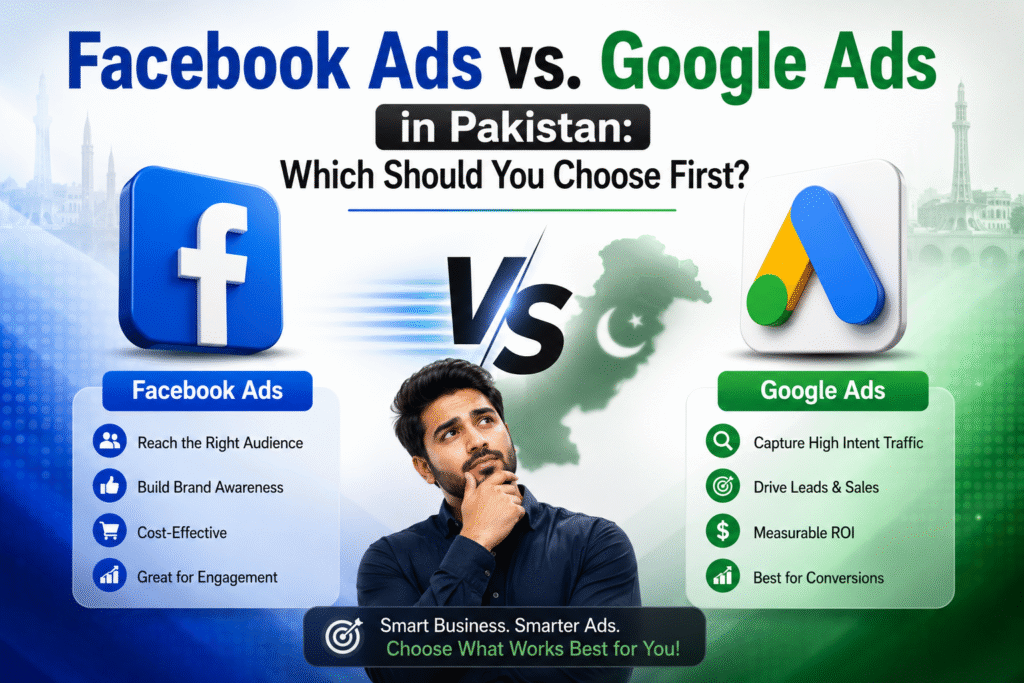
You’ve decided it’s time to put real budget behind paid advertising. Good — but now comes the question that stalls a lot of Pakistani business owners right at the starting line: Facebook Ads or Google Ads? Both platforms work. Both have genuine success stories. And most generic advice online just picks a side without explaining why, which isn’t actually useful when it’s your budget on the line.
This guide breaks down how each platform actually works, what each costs in Pakistan right now, and a clear framework for choosing based on your specific business — not a one-size-fits-all answer. Where relevant, we’ll note how Pentox Studio approaches this decision with clients, but the goal here is to make you confident making this call yourself.
Quick Primer: How Each Platform Actually Works
| Image Title | Two Advertising Philosophies Illustration |
| Placement | Directly under this H2 |
| AI Prompt | Flat vector illustration of a search bar icon on one side and a social feed icon on the other, connected by a subtle dividing line, teal and navy palette, clean minimal style, no text, no logos. |
| ALT Text | Illustration contrasting a search bar and a social feed, representing Google Ads and Facebook Ads |
| Caption | Same goal — new customers — but the two platforms find them in fundamentally different ways. |
Google Ads: Capturing Existing Demand
Google Ads shows your ad to people actively searching for something related to what you sell. You bid on keywords, and when someone searches that term, your ad can appear above the organic results. The core strength is intent: the person is already looking, which is why Google Ads tends to produce higher-intent clicks, even at a higher cost per click.
Facebook Ads: Creating Demand
Facebook (Meta) Ads work differently — you’re not waiting for someone to search, you’re placing your ad in front of people who match a target audience profile, based on interests, behavior, and demographics, while they’re scrolling their feed. This makes Facebook Ads better suited to generating interest in something people weren’t actively looking for yet, and to highly visual products and services.
What Each Platform Actually Costs in Pakistan (2026)
Real numbers matter more than generic advice here. Current Pakistan-focused advertising cost data (aggregated across multiple sources, not a single quote) shows a meaningful cost difference between the two platforms:
| Metric | Facebook / Meta Ads | Google Ads |
| Typical CPC (Cost Per Click) | Roughly PKR 10 to PKR 400, depending on audience and season | Roughly PKR 20 to PKR 250+, higher for competitive terms like legal or real estate |
| Typical CPM (Cost Per 1,000 Impressions) | Roughly PKR 150 to PKR 1,100 | Not typically sold on CPM for search campaigns |
| Minimum Practical Daily Budget | Often lower entry point for awareness campaigns | Generally PKR 1,500-5,000/day for meaningful search testing |
| What Drives the Cost | Audience size, competition for that audience, season | Keyword competitiveness, industry, Quality Score |
The headline takeaway: Facebook Ads are often the cheaper entry point per click, but Google Ads clicks tend to come from people already searching with intent — meaning a more expensive click can still produce a better return if it converts at a meaningfully higher rate. Cost per click alone doesn’t tell you which platform is the better investment; cost per converted customer does.
Targeting: Interest-Based vs. Intent-Based
| Image Title | Targeting Approaches Illustration |
| Placement | Directly under this H2 |
| AI Prompt | Flat vector illustration of a magnifying glass over a search bar on one side and a target/bullseye over a group of small figures on the other side, teal and navy palette, minimal clean style, no text, no logos. |
| ALT Text | Illustration comparing intent-based search targeting and interest-based audience targeting |
| Caption | Google finds people already looking. Facebook finds people who look like your best customers. |
- Google Ads targets by keyword and search intent — you reach people at the exact moment they’re looking for something related to what you sell
- Facebook Ads targets by demographics, interests, and behavior — including “lookalike audiences” built from your existing customers, letting you reach people who resemble your best buyers even if they’ve never searched for you
- Facebook’s retargeting (showing ads to people who already visited your site) is particularly strong and often underused by Pakistani small businesses
Ad Formats: Text-Driven vs. Visual-Driven
Google Ads’ search campaigns are primarily text — a headline, description, and a few extensions, competing for attention in a results list. Facebook Ads are inherently visual — images, video, carousels, and Stories/Reels formats that blend into the scrolling feed. This has a real practical implication: businesses with strong visual products (fashion, food, real estate, interior design) tend to get more mileage from Facebook’s ad formats, while businesses selling based on immediate need (repair services, legal help, urgent B2B services) tend to perform better with Google’s search-intent format.
Head-to-Head: Facebook Ads vs. Google Ads
| Factor | Facebook Ads | Google Ads |
| Best For | Building awareness, visual products, reaching new audiences | Capturing existing demand, urgent or need-based services |
| Typical Cost Per Click | Lower on average | Higher on average, but often higher intent |
| Targeting Strength | Interests, behavior, lookalike audiences | Search keywords and intent |
| Ad Format | Visual — image, video, carousel, Stories/Reels | Primarily text-based search ads |
| Speed to Results | Fast, especially for awareness metrics | Fast, especially for direct-response conversions |
| Best Business Type | E-commerce, real estate, food, fashion, lifestyle | Service businesses, urgent needs, B2B with clear search terms |
A Simple Framework for Choosing
| Image Title | Decision Framework Illustration |
| Placement | Directly under this H2 |
| AI Prompt | Flat vector illustration of a simple decision-tree diagram with two branching paths leading to a coin icon and a shopping bag icon, teal and navy palette, minimal style, no text, no logos. |
| ALT Text | Illustration of a decision tree representing choosing between Facebook Ads and Google Ads |
| Caption | The right platform depends on how your customers actually discover businesses like yours. |
- If your customers actively search for what you offer (“plumber near me,” “lawyer for [specific issue]”), start with Google Ads — you’re capturing demand that already exists
- If your product is highly visual and people don’t yet know they want it (a new fashion line, a home décor brand), start with Facebook Ads to build awareness and demand
- If your budget is very limited, Facebook Ads’ typically lower entry cost makes it easier to test and learn without burning through budget quickly
- If you’re in a high-CPC industry on Google (legal, real estate, education), weigh Facebook more heavily, since Google clicks get expensive fast in these categories
- If you have budget for both, use Facebook for top-of-funnel awareness and retargeting, and Google Ads to capture the resulting search demand — they complement each other well
Lead Generation by Industry: Facebook or Google First?
| Industry | Recommended First Platform | Why |
| E-commerce / Retail Brands | Facebook Ads | Visual products, strong for discovery and retargeting |
| Real Estate Agencies | Facebook Ads (with Google for high-intent search) | Property browsing is visual; Google captures active buyers |
| Law Firms | Google Ads | Clients search urgently for specific legal help |
| Construction Companies | Google Ads | B2B buyers often search directly for contractors |
| Medical Billing Companies | Neither as primary — LinkedIn and SEO usually matter more | B2B, remote sales cycle less suited to either platform alone |
| Local Service Businesses | Google Ads | Urgent, need-based searches convert well |
| Restaurants / Food Brands | Facebook Ads | Highly visual, impulse-driven decisions |
Illustrative Case Study: Testing Both Platforms Before Committing
| Image Title | Case Study Testing Illustration |
| Placement | Directly under this H2 |
| AI Prompt | Flat vector illustration of two small test-tube icons, one labeled with a search icon and one with a social feed icon, both feeding into a single results chart, teal and navy palette, minimal clean style, no text, no logos. |
| ALT Text | Illustration of two advertising platforms being tested and compared through a results chart |
| Caption | A structured, side-by-side test tells you more in a month than months of guessing. |
After three to four weeks, they compare not clicks or impressions, but actual booked jobs per platform and the cost of acquiring each one. In a scenario like this, Google Ads would typically produce fewer but more immediately ready customers, since someone searching “same day AC repair” has already decided they need help now. Facebook would typically produce more clicks at a lower cost, but a portion of those clicks come from people who weren’t actively in-market yet — some convert immediately, others need a follow-up message or a retargeting ad days later before they book.
The lesson this kind of structured test teaches: for an urgent, need-based service like this, Google Ads likely becomes the primary channel once the test period ends, with Facebook retained specifically for retargeting people who clicked but didn’t book right away — rather than either platform being written off entirely based on the first impression.
Advanced Tips for Getting More From Either Platform
- Layer Facebook’s retargeting audience with Google’s Customer Match feature so past website visitors see consistent messaging across both platforms, rather than starting from zero on each
- Use Google Ads’ search term reports to discover new keyword opportunities, then test those same themes as Facebook ad copy angles — cross-pollinating insights between platforms rather than treating them as fully separate silos
- For Facebook, rotate ad creative every 2-3 weeks to avoid “ad fatigue,” where the same audience sees the same ad so often that engagement quietly declines
- For Google Ads, regularly review the Quality Score components (expected click-through rate, ad relevance, landing page experience) rather than just adjusting bids — a Quality Score improvement often reduces cost per click more effectively than bidding higher
- Set up conversion tracking properly on both platforms before spending seriously — optimizing toward vanity metrics like clicks or reach, instead of actual bookings or sales, is one of the most expensive mistakes in paid advertising
Which Metrics Actually Matter
Both platforms surface a lot of numbers, and it’s easy to get distracted by the ones that look impressive rather than the ones that matter financially. Reach and impressions describe how many people saw your ad — useful for context, but not a measure of business impact on their own. Click-through rate tells you whether your ad or targeting is compelling enough to earn a click, which matters, but still isn’t the final measure. The numbers that actually determine whether a campaign is worth continuing are cost per lead, cost per acquired customer, and — ultimately — return on ad spend, meaning how much revenue came back relative to what was spent. Building a habit of checking these three figures weekly, rather than getting reassured by a high reach number, is what separates advertising that pays for itself from advertising that just feels active.
Common Mistakes Businesses Make With This Decision
- Choosing a platform based on what a competitor uses, rather than how their own customers actually search or discover businesses
- Judging Facebook Ads as “cheaper” purely on cost-per-click without checking whether those clicks actually convert
- Running Google Ads for a highly visual, low-urgency product that would perform better with Facebook’s discovery-driven format
- Splitting a very small budget evenly across both platforms, underfunding each so neither produces meaningful, measurable results
- Ignoring Facebook’s retargeting capability entirely, missing an inexpensive way to re-engage people who already showed interest
Expert Tips
- Track cost per converted customer, not just cost per click — the platform with the higher CPC sometimes still wins on real ROI
- Use Facebook’s pixel to build a retargeting audience from day one, even if your primary spend is on Google Ads
- Test with a modest budget on both platforms before committing fully to one, if your budget genuinely allows it
- Match ad format to platform strength — don’t force a text-heavy value proposition into Facebook’s visual format, or vice versa
Business Examples: How This Decision Plays Out
| Image Title | Business Platform Choice Examples Illustration |
| Placement | Directly under this H2 |
| AI Prompt | Flat vector illustration of three small distinct business icons — a clothing rack, a gavel, and a house — each connected to either a social feed icon or a search bar icon, teal and navy palette, minimal style, no text, no logos. |
| ALT Text | Illustration of three business types connected to different advertising platform icons |
| Caption | The right platform choice often becomes obvious once you think about how your specific customer actually shops. |
Example: A Fashion E-Commerce Brand
A Lahore-based clothing brand would typically start with Facebook and Instagram Ads to showcase new collections visually, using retargeting to bring back visitors who browsed but didn’t purchase, with Google Shopping ads added later to capture people actively searching for specific items.
Example: A Law Firm
A law firm would typically prioritize Google Ads, since prospective clients search directly and urgently for specific legal help (“family lawyer in Karachi”) — a moment Facebook’s interest-based targeting can’t replicate as precisely.
Example: A Real Estate Agency
A real estate agency would typically run both: Facebook and Instagram for visually showcasing listings and building interest, alongside Google Ads (and strong local SEO) to capture buyers already searching for property in a specific area.
Running Both Platforms Together
For businesses with adequate budget, running Facebook and Google Ads together — rather than choosing one permanently — is often the strongest long-term approach. A common, sensible pattern: Facebook builds awareness and feeds a retargeting audience, while Google Ads captures the resulting search demand from people who’ve now heard of you. Each platform makes the other more effective rather than competing for the same budget in isolation.
How Pentox Studio Approaches This Decision
Rather than defaulting to one platform, Pentox Studio typically starts by understanding how a client’s actual customers discover and evaluate businesses like theirs — a visual, discovery-driven purchase gets a different starting recommendation than an urgent, search-driven one. For clients with budget for both, Facebook and Google campaigns are often coordinated together, with retargeting data from one informing targeting decisions on the other.
Frequently Asked Questions
1. Which is better for small businesses in Pakistan, Facebook Ads or Google Ads?
Neither is universally better — Facebook Ads suit visual, discovery-driven businesses, while Google Ads suit businesses whose customers actively search for them. The right choice depends on your specific product, customer behavior, and how urgently people typically need what you offer.
2. Is Facebook advertising cheaper than Google Ads in Pakistan?
Often yes, on a pure cost-per-click basis — roughly PKR 10-400 for Facebook versus PKR 20-250+ for Google Ads — but a cheaper click isn’t automatically a better investment if it converts at a lower rate. Always compare cost per actual customer, not just cost per click, before deciding either platform is objectively cheaper for your business.
3. Can I run Facebook Ads and Google Ads at the same time?
Yes, and for businesses with adequate budget, this is often the strongest approach — Facebook builds awareness and retargeting data while Google Ads captures the resulting search demand. Many successful campaigns in Pakistan use both platforms in a coordinated way rather than choosing one exclusively.
4. Which platform is better for e-commerce businesses?
Facebook Ads typically perform well for e-commerce discovery and retargeting, often paired with Google Shopping ads to capture people actively searching for specific products by name or category.
5. Which platform is better for service-based businesses?
Google Ads often performs better for service businesses, since customers frequently search directly and urgently for services like legal help, repairs, or contractors — moments where Facebook’s interest-based targeting can’t replicate the same precision.
6. How much should I budget to test Facebook Ads or Google Ads?
A modest test budget over 2-4 weeks on each platform, tracked carefully for cost per converted customer rather than just clicks, gives a far more reliable answer than guessing based on cost-per-click alone or assuming one platform’s reputation applies to your specific business.
7. Do Facebook Ads work for B2B businesses in Pakistan?
Less reliably than for consumer businesses — B2B lead generation in Pakistan often leans more heavily on LinkedIn, SEO, and direct outreach than Facebook Ads specifically.
8. What is retargeting, and why does it matter?
Retargeting shows ads to people who already visited your website or engaged with your content — Facebook’s retargeting tools are particularly strong and often produce a lower cost per conversion than cold audience targeting.
9. Which platform is better for building brand awareness?
Facebook Ads, generally — its visual formats and interest-based targeting are better suited to introducing a business to people who don’t yet know they want what you offer.
10. Which platform gives faster results?
Both can produce results within days, but they measure different things quickly — Facebook often shows fast engagement and awareness metrics, while Google Ads often shows fast direct-response conversions.
11. Is Google Ads worth the higher cost per click?
Often yes for businesses with real search intent behind their product, since the higher cost frequently reflects a buyer closer to a purchase decision — but this should be verified with your own conversion data, not assumed.
12. What’s the biggest mistake businesses make choosing between these platforms?
Choosing based on cost-per-click alone rather than cost per converted customer, or splitting a very limited budget evenly across both and underfunding each.
13. Which platform is better for real estate marketing in Pakistan?
Often both together — Facebook and Instagram for visually showcasing properties, and Google Ads (plus strong local SEO) for capturing buyers already searching in a specific area.
14. Do I need a large budget to start with either platform?
No — both platforms allow relatively small test budgets, though Google Ads generally needs a slightly higher daily minimum to gather meaningful search data quickly.
15. How do I know if my ads are actually working?
Track conversions and cost per converted customer in each platform’s own analytics, not just clicks or impressions — a cheap click that never converts is more expensive than an effective, pricier one.
16. Which platform works better for restaurants and food brands?
Facebook and Instagram Ads typically perform strongly here, given how visual and impulse-driven food-related purchase decisions tend to be.
17. Can Facebook Ads data help my Google Ads strategy, or vice versa?
Yes — audience insights and top-performing creative from Facebook can inform Google Display and YouTube campaigns, and high-converting Google search terms can inform Facebook audience targeting.
18. Is it better to hire an agency or manage ads myself?
Many fundamentals can be tested in-house with a modest budget; competitive industries or larger budgets often benefit from experienced management to avoid wasted spend during the learning curve.
19. Which platform has better targeting options?
Facebook offers deeper interest and behavior-based targeting, including lookalike audiences; Google offers precise intent-based targeting through keywords. They’re different strengths, not directly comparable on a single scale.
20. How does Pentox Studio decide which platform to recommend?
By assessing how a specific client’s customers actually discover and evaluate businesses like theirs, rather than defaulting to one platform regardless of business type.
Conclusion: The Right Platform Depends on How Your Customers Actually Shop
Facebook Ads and Google Ads solve genuinely different problems: one creates demand among people who don’t yet know they want what you offer, the other captures demand from people already searching for it. Neither is a universal answer — the right starting point depends on whether your business sells on discovery or on urgency.
If your customers search for what you offer, start with Google Ads. If your product needs to be seen to be wanted, start with Facebook. And if your budget allows it, running both together — with each platform’s data informing the other — is often the strongest approach of all.
Not sure which platform fits your specific business? Request a free consultation or a paid advertising audit from Pentox Studio — we’ll walk through your customers’ actual behavior before recommending either platform.