
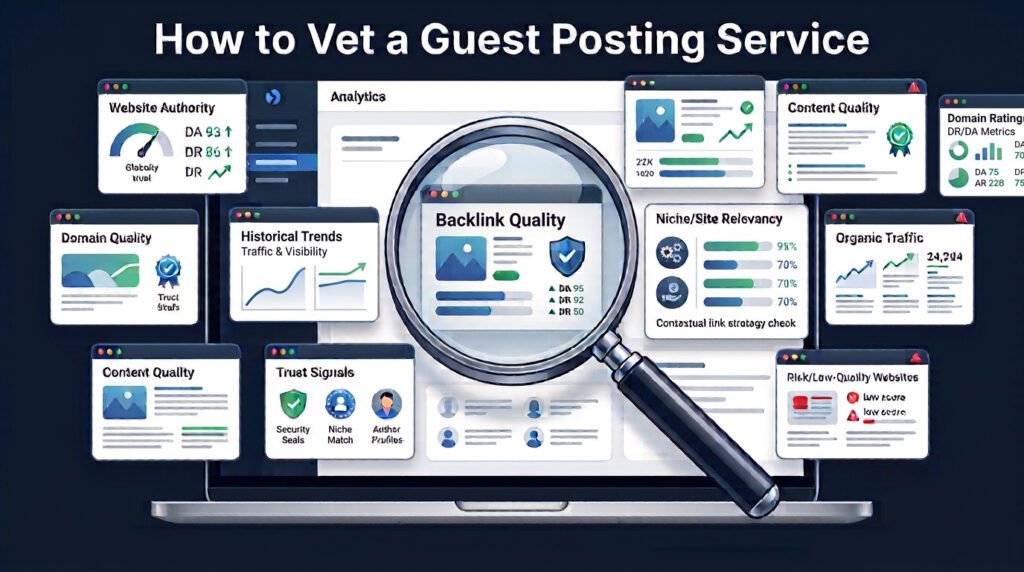
How to Vet a Guest Posting Service Before You Pay for a Single Link
Introduction
If you’ve searched for a guest posting service in the last year, you’ve probably noticed something odd: almost every result is either a vendor ranking its competitors, or a checklist so short it tells you to “avoid spammy sites” without explaining how to actually recognize one. Meanwhile, guest posting has a real trust problem. Google has spent the last several update cycles specifically targeting link networks that dress themselves up as editorial content, and plenty of small businesses have paid for placements that did nothing — or worse, dragged their rankings down.
None of that means guest posting is dead. Used correctly, it’s still one of the more reliable ways to earn relevant, contextual backlinks and put your brand in front of a new, already-engaged audience. The difference between a guest post that helps your site and one that quietly damages it almost always comes down to one thing: who placed it, and how carefully they vetted the site before you paid for it.
This guide is a practical, vendor-neutral buyer’s checklist. If you’re a small business owner, startup founder, or in-house marketer deciding whether to hire a guest posting service — and which one — you should be able to run through this guide once and vet any vendor with confidence, whether you end up working with an agency, a freelancer, or nobody at all.
Quick Answer
A trustworthy guest posting service will show you the target site before you pay, disclose real organic traffic (not just a Domain Rating score), place your content only on topically relevant publications, write original content reviewed by an actual editor, use natural (not exact-match, keyword-stuffed) anchor text, and never guarantee a specific ranking position. If a vendor won’t do all six, keep looking.
What a Guest Posting Service Actually Does
A guest posting service researches and reaches out to blogs and publications in or near your niche, pitches or writes an article that includes a contextual link back to your site, and manages the placement and (ideally) reporting. Some vendors run their own network of publisher relationships; others do live outreach for each client. Neither model is inherently better — the vetting criteria below apply to both.
The service exists to save you the two hardest parts of link building yourself: finding sites that will actually say yes, and writing content good enough that a real editor accepts it. What you’re paying for is access and craft, not the link itself — that distinction matters when you’re judging price and value later in this guide.
Why Guest Posting Still Works — and Why It Also Still Gets Businesses Penalized
Google doesn’t treat all guest posts the same way. Its Search Central guidance on link spam is specific: it’s the pattern, not the format, that draws scrutiny — large-scale guest posting distributed across many sites with optimized, commercial anchor text, published purely to pass link equity rather than to inform a publication’s own readers.
A single, well-placed, genuinely useful article on a relevant site with a natural link is normal editorial practice and has never been the target of enforcement. The businesses that get burned are the ones buying volume from vendors who publish the same recycled article structure across dozens of low-traffic sites with commercial anchor text like “best accounting software” repeated verbatim. That’s a link scheme in Google’s own definition, regardless of who’s selling it to you.
This is exactly why vetting the vendor, not just the price, is the whole game.
The 8-Step Vetting Process
Step 1: Ask for the site list before you pay — not after. Reputable vendors will tell you, or at minimum show you examples from, the publications they place on before you commit. If a vendor refuses to name any target sites until after payment clears, that’s the single strongest red flag in this entire guide. You are being asked to buy blind.
Step 2: Check real traffic, not just a DR/DA score. Domain Rating and Domain Authority are third-party metrics that estimate link profile strength — they say nothing about whether a site has actual readers. A site can carry an impressive DR while receiving close to zero organic visitors, which is the classic signature of an artificially inflated link farm. Ask the vendor what organic traffic estimate they use for qualifying sites, and cross-check a sample site yourself using any free traffic-estimation tool.
Step 3: Confirm topical relevance. A link from a site in your actual industry or a closely adjacent one carries far more weight — and far less risk — than a link from an unrelated general-interest blog that happens to accept any topic for a fee. Ask how the vendor matches sites to your niche, and look at a few of their past placements to see whether the subject matter genuinely fits the host site’s usual content.
Step 4: Review a writing sample and ask who edits it. Ask for a sample of a recently placed article, written for a client in a different niche if needed for confidentiality. Read it as if you were the host site’s own reader: does it stand on its own as something worth reading, or does it read like filler built around a link? Ask whether the host site’s editor reviews and can reject content — a “yes, always” is a strong positive signal; “we submit directly with no review” is not.
Step 5: Ask about anchor text policy. A safe, natural anchor text profile is heavily weighted toward your brand name and bare URL, with only a modest share of partial-match or natural phrase anchors — and almost no exact-match commercial anchors repeated across placements. Ask the vendor directly what their default anchor text mix looks like. Vendors who don’t have an answer usually don’t have a policy.
Step 6: Ask what happens if the post gets removed. Guest posts do sometimes get taken down — a site changes ownership, does a content purge, or an editor reconsiders. Ask what guarantee, if any, the vendor offers if your placement disappears within a defined window (three to six months is a reasonable ask).
Step 7: Get everything in writing. Before paying, get a written scope covering: the number of placements, the minimum traffic/relevance standard, whether links are dofollow or nofollow/sponsored, turnaround time, and the replacement policy above. A vendor unwilling to put any of this in a simple order confirmation or contract is a vendor unwilling to be held to it later.
Step 8: Audit the live placement after publication. Once the post is live, check three things yourself: the link actually resolves to your site (not a redirect chain), the anchor text matches what was agreed, and the page is indexed (a simple site: search or a check in Google Search Console’s URL inspection tool will confirm this). Don’t assume — verify.
Red Flags That Should End the Conversation Immediately
- The vendor won’t disclose target sites until after payment.
- Pricing is dramatically below market with no explanation of why.
- The “sites” offered are actually a marketplace listing hundreds of interchangeable blogs with no stated editorial process.
- The vendor guarantees a specific Google ranking position — no legitimate link building service can promise this, because it isn’t within any vendor’s control.
- Heavy, exact-match commercial anchor text is offered as the default, or encouraged, without you asking for it.
- The same article template appears to be reused with minor edits across many “different” client placements (ask to see two samples from different clients side by side).
- Publishing volume is unusually high relative to price — a handful of well-placed articles a month is a realistic, sustainable pace; dozens per month at bargain pricing is a pattern associated with link farms.
What Fair Pricing Looks Like
Exact pricing varies widely by market, niche competitiveness, and site quality tier, and this guide won’t invent specific numbers as if they were universal. As a general orientation: higher-traffic, higher-relevance placements on sites with a genuine editorial process cost meaningfully more than bulk placements on marketplace-style sites, and that gap exists for a reason — the vetting and outreach behind a quality placement is real labor, not a markup for its own sake. Be more suspicious of a price that seems too low for the promised site quality than one that seems high; the failure mode that actually damages sites is almost always underpriced volume, not overpriced quality.
DIY vs. Hiring a Guest Posting Service
| Factor | Do it yourself | Hire a service |
|---|---|---|
| Time investment | High — outreach, follow-ups, and content take real hours weekly | Low — you review and approve, vendor executes |
| Existing publisher relationships | None to start; built slowly | Often already in place, if genuinely vetted |
| Control over site selection | Full | Depends entirely on vendor transparency (see Step 1) |
| Cost | Time cost, little or no cash cost | Cash cost, minimal time cost |
| Best for | Businesses with in-house content skill and time to build relationships over months | Businesses that need placements faster than in-house capacity allows, and can vet a vendor properly |
Neither path is automatically safer — a poorly-run DIY outreach campaign using recycled, keyword-stuffed pitches carries the same spam risk as a bad vendor. The vetting standards in this guide apply to your own outreach process just as much as to a vendor’s.
Common Mistakes Small Businesses Make
- Choosing a vendor by DR alone and skipping traffic verification.
- Paying for a large batch of placements up front before confirming the quality of a single sample.
- Accepting exact-match commercial anchor text because it “sounds better for SEO” — it’s the opposite; natural anchors are safer and, over time, more effective.
- Treating guest posting as a one-off purchase rather than an ongoing, moderate-pace part of a broader content and SEO strategy.
- Never checking the placement after it goes live.
Best Practices for Ongoing Guest Posting
- Set a steady, moderate cadence rather than a single large burst.
- Diversify anchor text toward brand and natural phrases.
- Prioritize topical relevance over raw authority metrics.
- Track referral traffic and indexing status per placement, not just link count.
- Treat every placement as content that should be genuinely useful to the host site’s own readers first, and a backlink second.
Frequently Asked Questions
Is guest posting still safe for SEO in 2026? Yes, when it follows normal editorial practice: relevant sites, original content, natural anchors, and no artificial scale. The risk comes from the pattern of large-scale, low-relevance, keyword-anchor-heavy placements that Google’s own spam guidance specifically describes — not from guest posting itself.
What is a good Domain Rating for a guest post site? There’s no single universal number, and DR/DA alone is not a reliable quality signal. A site with a strong DR but no real organic traffic is a weaker placement than a site with a moderate DR and a genuine, engaged readership in your niche.
How many guest posts do I need per month? This depends on your competitive landscape and budget, but a steady, moderate pace sustained over months is a safer and more effective pattern than a single large batch.
Can I get penalized for guest posts I paid for? Yes, if the pattern matches what Google’s guidance defines as a link scheme — particularly large volume, low relevance, and optimized commercial anchor text. A single well-placed, relevant post is not the target of that enforcement.
Should guest post links be dofollow or nofollow? Reputable publishers make this decision based on their own editorial standards, not a paid arrangement. Sponsored or paid placements should be marked accordingly per search engine guidelines; a vendor pushing you to demand dofollow on every paid placement regardless of the host site’s own policy is a signal worth questioning.
Is it better to hire an agency or a freelancer? Either can be legitimate. The vetting criteria in this guide — transparency, real traffic, relevance, editorial review, anchor policy — matter more than whether the provider is a solo freelancer or a full agency.
What should I do if I think I’ve already been penalized from bad guest posts? Start by identifying which links are low-quality or irrelevant using a backlink audit tool, then work through a disavow or removal process as appropriate, and shift going forward to the vetting standards in this guide. Recovery is realistic but takes sustained, patient work rather than a quick fix.
How is guest posting different from paid links? Guest posting is a broader practice that includes both editorial placements earned through pitching and content, and paid arrangements. What determines risk isn’t whether money changed hands, but whether the resulting link is disclosed appropriately and whether the placement reflects genuine editorial value versus a pure pay-for-link scheme.
Do I need a guest posting service if I already do SEO myself? Not necessarily. If you already have the time and relationships to build placements yourself, a service may not add much. Many small businesses use a service specifically because outreach and relationship-building is the most time-consuming part of link building, not because they lack SEO knowledge generally.
What’s the single most important question to ask a vendor before paying? “Can you show me the specific site you’ll place my content on before I pay?” A vendor’s answer to that one question tells you almost everything else you need to know.
Conclusion
Guest posting hasn’t stopped working — but the margin between a placement that helps your site and one that quietly damages it has gotten thinner as enforcement has gotten smarter. The good news is that the vetting process itself isn’t complicated: ask to see the site first, verify real traffic instead of trusting a single metric, confirm topical relevance, read an actual writing sample, ask about anchor text policy, get terms in writing, and check the live placement afterward. Run any vendor — or your own in-house process — through those eight steps, and you’ll avoid the vast majority of guest posting mistakes that cost small businesses money and rankings.
Need help implementing this — or want an existing backlink profile reviewed before you invest further in guest posting? Talk to Pentox Studio about your next SEO or link building project.