
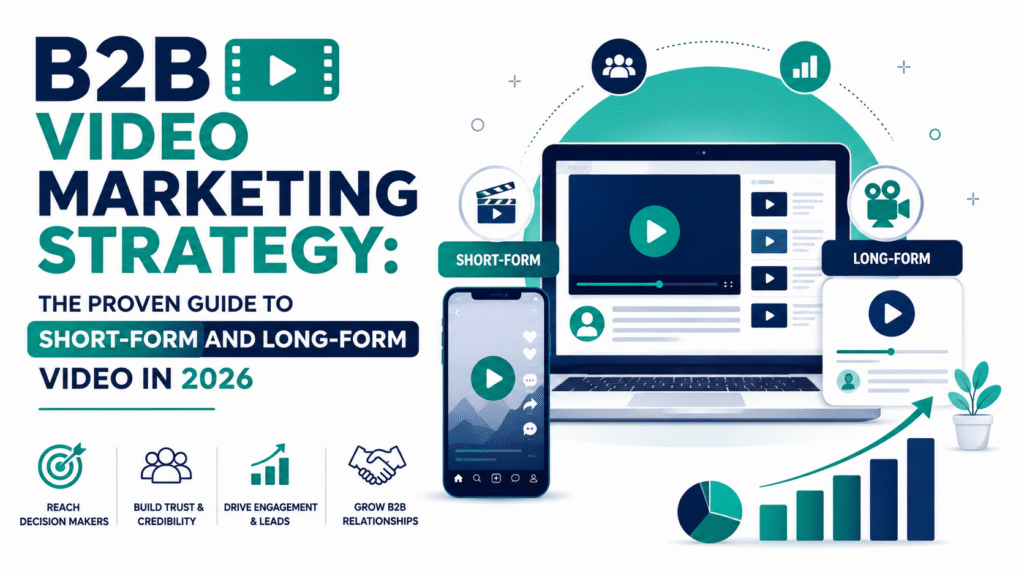
Here’s a genuine paradox sitting in the middle of B2B video marketing right now: marketers rank short-form video, anything under 60 seconds, as the single highest-ROI content format for the third year running. At the same time, data on long-form video, 30 to 60 minutes, shows lead-generation forms placed behind that content converting at rates as high as 65%. Both of these are true simultaneously, and almost nothing published treats them as two tools for two different jobs rather than competing answers to the same question.
This guide covers exactly that: what B2B video marketing actually requires in 2026, when short-form earns its keep and when long-form does, platform-specific strategy for LinkedIn and YouTube specifically, and a practical framework for building a video content plan around your actual sales cycle rather than copying whichever format is trending. Pentox Studio produces and edits video as part of a connected content strategy, and where it’s useful we’ll reference that directly.
What B2B Video Marketing Actually Requires in 2026
| Image Title | B2B Video Format Split Illustration |
| Placement | Directly under this H2 |
| AI Prompt | Flat vector illustration of a video play button splitting into two paths, one short and quick with a stopwatch icon, one longer with a document/form icon at the end, teal and navy palette, minimal clean style, no text, no logos. |
| ALT Text | Illustration of a video play button splitting into a short-form path and a long-form path with a lead form |
| Caption | Same format, two different jobs, treating them as interchangeable is where most B2B video strategy goes wrong. |
With 91% of businesses now actively using video as a marketing tool, video itself is no longer a differentiator, it is table stakes. What differentiates B2B companies in 2026 is whether video is produced with a specific job in mind (attention capture versus deep evaluation) or produced generically and distributed everywhere, hoping it works. Content Marketing and Video Editing, treated as one connected discipline rather than separate tasks handed to different people, is what actually produces the strategic clarity most B2B video efforts lack.
The Short-Form vs. Long-Form Paradox, Explained
- Short-form video (under 60 seconds) delivers roughly 2.5x more engagement per impression than any other content format, and is the format marketers most consistently rate as highest-ROI
- Long-form video (30-60 minutes) shows lead-generation forms placed at the end converting at rates as high as 65%, since only genuinely committed prospects watch that far
- The resolution isn’t choosing one, short video captures broad attention efficiently; long video serves and qualifies prospects who are already seriously evaluating you
Short-Form vs. Long-Form Video: A Direct Comparison
| Factor | Short-Form (Under 60 Seconds) | Long-Form (30-60 Minutes) |
| Primary Job | Capture attention, build awareness at scale | Qualify and convert already-interested prospects |
| Typical Engagement | 2.5x more engagement per impression than other formats | Lower reach, but far higher intent among viewers who finish |
| Lead Conversion | Rarely gated behind a form directly | Forms behind long-form content convert at rates up to 65% |
| Production Cost | Lower per piece, suited to frequent, repeatable output | Higher per piece, suited to fewer, higher-stakes assets |
| Best Use Case | Top-of-funnel awareness, LinkedIn and social feed distribution | Bottom-of-funnel evaluation content, webinars, deep product walkthroughs |
| Platform Fit | LinkedIn, Instagram Reels, YouTube Shorts, TikTok | YouTube, gated landing pages, sales enablement |
LinkedIn Video Strategy for B2B Companies
| Image Title | LinkedIn Video Strategy Illustration |
| Placement | Directly under this H2 |
| AI Prompt | Flat vector illustration of a professional feed interface with a video play icon and small engagement metric icons around it, teal and navy palette, minimal clean style, no text, no logos. |
| ALT Text | Illustration of a professional social feed with a video post and engagement icons representing LinkedIn video strategy |
| Caption | LinkedIn video succeeds on clarity and pacing now, not production polish. |
LinkedIn dominates B2B video distribution, and current data shows native video achieving 5.1-6% engagement compared to 2-3% for static image posts. Vertical video formats specifically show 34% higher engagement and 34% longer dwell time than traditional square-format content, yet a striking 65% of B2B videos on LinkedIn still lack a clear call-to-action, a straightforward, high-impact fix available to almost any business already producing video.
What Actually Works on LinkedIn in 2026
- Build a repeatable video series with a consistent theme and hook style, rather than one-off campaign videos, series-based content outperforms isolated posts by building audience habit
- Optimize for mobile and vertical framing specifically, and deliver the core point within the first two seconds
- Pair video with a companion document carousel or multi-image post to extend engagement and save and share behavior
- Always include a specific call-to-action, closing the gap the majority of current B2B LinkedIn video is leaving open
YouTube’s Role: SEO and Longevity
Where LinkedIn suits B2B value per impression, YouTube plays a different role entirely: SEO and longevity. A well-produced explainer or product demo video on YouTube keeps generating views and search visibility long after a LinkedIn post has scrolled out of anyone’s feed. This is also where Graphic Design and Branding consistency matters directly, thumbnail design and channel presentation materially affect click-through rate on a platform where visual browsing, not just algorithmic feed placement, drives discovery.
AI’s Growing Role in Video Production
AI-powered editing, scripting, voiceover, and generation tools have measurably changed the economics of B2B video: average production cost has dropped from roughly $4,200 to $2,500 per finished minute, and a majority of forward-thinking marketing teams now use AI tools specifically to edit and scale output without expanding headcount. This cost compression is a genuine opportunity for small and mid-size B2B companies that previously couldn’t justify a real video budget, but it also means production quality alone is no longer a differentiator, since more competitors can now afford a baseline of professional-looking output. Strategy and clarity, not just access to better tools, is what separates results now.
Measuring ROI: Beyond Views and Engagement
With 90% of marketers reporting positive ROI from video and 78% confirming it directly increases sales, the aggregate case for video is settled. The harder, more useful question for an individual business is which specific videos are actually contributing to that ROI, since views and engagement, the metrics most dashboards surface first, don’t answer that question on their own.
- Track conversions attributable to a specific video, not channel-wide averages, a gated long-form asset’s conversion rate tells you far more than its view count does
- Compare cost per finished minute against the pipeline or revenue that specific asset can be tied to, rather than treating production cost as a fixed, unexamined line item
- Watch completion rate alongside view count, a video with high views but low completion is capturing attention it isn’t holding, worth revisiting the hook and pacing before assuming the topic itself failed
The Three Video Types That Actually Convert
Testimonial videos, product demos, and explainer videos consistently rank as the highest-converting B2B video types. If a business can only produce three formats this year, these are the three worth prioritizing over trend-chasing content.
Testimonial Videos
Real client voices carry a credibility no branded messaging can replicate. Even a short, unpolished testimonial (genuine over glossy) tends to outperform a heavily produced but generic brand video for building trust with a skeptical B2B buyer.
Product Demos
Showing the actual product solving a real problem, rather than describing it, meets buyers at the exact moment they are comparing options seriously. These tend to work well in both short-form (a 30-second feature highlight) and long-form (a full walkthrough) versions.
Explainer Videos
Videos that clarify a genuinely confusing concept or process build the same kind of trust that well-structured Content Marketing builds in written form, and often serve as a business’s most durable, evergreen video asset.
Mapping Video Format to Your Actual Sales Cycle
| Image Title | Video Sales Cycle Mapping Illustration |
| Placement | Directly under this H2 |
| AI Prompt | Flat vector illustration of a horizontal funnel with three stages, each stage showing a small video play icon of a different size, teal and navy palette, minimal clean style, no text, no logos. |
| ALT Text | Illustration of a sales funnel with different video sizes representing content matched to each buyer stage |
| Caption | The right video length depends on where the viewer actually is in their decision, not on what is trending. |
| Funnel Stage | Recommended Format | Goal |
| Awareness | Short-form (under 60 seconds) | Broad reach, pattern-interrupt, brand familiarity |
| Consideration | Medium-length (2-5 minutes) | Product demos, specific use-case explainers |
| Decision | Long-form (30-60 minutes), often gated | Deep evaluation content for committed, high-intent prospects |
Step-by-Step Guide: Building a B2B Video Content Plan
- Audit your current sales cycle and identify where prospects genuinely get stuck or drop off, this tells you which funnel stage needs video most urgently
- Choose one testimonial, one demo, and one explainer as your first three production priorities, rather than spreading across many formats immediately
- Match each video’s length to its funnel stage using the mapping above, rather than defaulting to whatever length is easiest to produce
- Build a repeatable short-form series for consistent top-of-funnel presence, publishing on a fixed cadence rather than sporadically
- Gate your strongest long-form asset behind a lead form, and track conversion rate specifically from that asset, not just overall video views
- Review performance quarterly and double down on whichever format is actually producing qualified leads, not just views
Illustrative Case Study: Two B2B Companies, Two Video Strategies
To make this concrete, here is an illustrative, not client-specific, comparison of two B2B software companies. Company A invested heavily in short-form video across every platform, publishing daily, and saw strong engagement metrics but struggled to connect that activity to actual pipeline. Company B built a smaller, more deliberate system: a weekly short-form LinkedIn series for awareness, three solid product demo videos for the consideration stage, and one long-form, gated product walkthrough specifically for prospects already in active sales conversations.
Company B’s short-form content produced lower raw engagement numbers than Company A’s daily output, but its gated long-form video converted a meaningfully higher share of viewers into sales-qualified leads, since only genuinely serious prospects watched that far. The lesson is not that short-form failed, it is that Company A never built the corresponding long-form asset to actually capture and convert the attention its short-form content was generating.
Common Mistakes in B2B Video Marketing
- Producing only short-form content and never building the long-form asset that would actually convert the attention it generates
- Publishing video without a clear call-to-action, a gap present in roughly 65% of current B2B LinkedIn video
- Treating every platform identically instead of adapting format and framing (vertical for LinkedIn, landscape for YouTube)
- Measuring success by views or engagement alone, without tracking which specific videos produce qualified leads
- Assuming AI-assisted production quality alone is a differentiator, when strategy and clarity now matter more as production costs fall industry-wide
Best Practices
- Pair short-form and long-form video deliberately, matched to funnel stage, rather than picking one format based on trend or personal preference
- Keep Branding and visual presentation consistent across video, thumbnails, and companion content, since inconsistency undermines the same trust video is meant to build
- Use Social Media Marketing distribution data to identify which topics and hooks are actually resonating, then feed that back into future video topics
- Run structured creative testing, a few hooks, lengths, and calls-to-action per topic, then scale only the versions that measurably perform
Expert Insights
- The businesses winning with B2B video in 2026 are not necessarily the ones with the biggest budgets, cost compression from AI tools has leveled much of that field, they are the ones with the clearest strategic mapping between video format and funnel stage
- Series-based video consistently outperforms one-off campaigns by building genuine audience habit and enabling more complex narratives across multiple videos
- The 65% missing-CTA gap in current LinkedIn B2B video represents one of the single easiest, highest-leverage fixes available to most businesses already producing video
A Practical 90-Day B2B Video Action Plan
| Timeframe | Focus |
| Days 1-30 | Sales cycle audit; produce first testimonial and demo video; launch a short-form LinkedIn series |
| Days 31-60 | Produce first explainer video; add clear CTAs across all existing video; begin structured hook and length testing |
| Days 61-90 | Produce and gate first long-form asset; review conversion data; double down on whichever format is producing qualified leads |
Checklist: Is Your B2B Video Strategy Actually Working?
- You have at least one testimonial, one demo, and one explainer video in active rotation
- Every published video includes a clear, specific call-to-action
- Short-form and long-form video are mapped deliberately to funnel stage, not chosen at random
- At least one long-form asset is gated behind a lead form and tracked for conversion specifically
- Video format and framing are adapted per platform, not published identically everywhere
- You track qualified leads generated by video, not only views or engagement
How Pentox Studio Approaches B2B Video Marketing
Rather than treating video production and content strategy as separate workstreams, Pentox Studio maps video format directly to a client’s actual sales cycle before producing anything, ensuring every asset, short or long, has a specific, measurable job to do. Video Editing is paired with Content Marketing and Social Media Marketing distribution strategy from the start, and Graphic Design and Branding consistency carries through thumbnails and companion content so video reinforces the same trust a client’s broader marketing is already building.
Frequently Asked Questions
1. What is B2B video marketing strategy?
A deliberate plan for what video formats to produce, matched to specific goals (awareness, consideration, or conversion) and specific platforms, rather than producing video generically and hoping it performs. It also means measuring success by qualified leads and pipeline contribution, not just views.
2. Is short-form or long-form video better for B2B marketing?
Neither is universally better, they serve genuinely different jobs. Short-form drives broad awareness and engagement efficiently and cheaply; long-form, particularly gated content, converts already-interested prospects at a much higher rate, since only committed viewers watch that far.
3. What is the best video length for B2B lead generation specifically?
Long-form video, roughly 30-60 minutes, gated behind a lead form shows conversion rates as high as 65% among viewers who reach that point, since only genuinely committed prospects watch that far. Shorter videos rarely convert at comparable rates when gated, since they don’t filter for the same level of buyer intent.
4. How much does B2B video production cost in 2026?
AI-assisted production has brought average costs down to roughly $2,500 per finished minute, down from about $4,200, though costs still vary significantly by complexity and quality level.
5. What are the highest-converting types of B2B video?
Testimonial videos, product demos, and explainer videos consistently rank as the highest-converting formats.
6. Should B2B companies use AI video tools?
Yes, generally, a majority of marketing teams now use AI tools for editing, scripting, and production to scale output without expanding headcount, though strategy still matters more than tooling alone.
7. Why do so many B2B LinkedIn videos underperform?
Roughly 65% of current B2B video on LinkedIn lacks a clear call-to-action, one of the simplest and most fixable gaps in an otherwise reasonable video strategy.
8. Is LinkedIn or YouTube better for B2B video?
They serve different roles. LinkedIn delivers the highest B2B value per impression for distribution and engagement; YouTube offers better long-term SEO visibility and searchability.
9. How often should a B2B company publish video content?
A consistent, repeatable cadence (commonly 2-4 short videos weekly for a series) tends to outperform sporadic, one-off campaign videos.
10. Does video length affect engagement rate on LinkedIn?
Yes, videos between 30-90 seconds see completion rates above 60%, while videos over two minutes see a sharp engagement drop-off on the platform.
11. What is the biggest mistake B2B companies make with video?
Producing only short-form content without ever building the corresponding long-form asset that would actually convert the attention that short-form content generates.
12. How do I measure whether my B2B video strategy is working?
Track qualified leads generated by specific videos, not just view counts or engagement rate, which measure attention but not business outcome.
13. Should video framing be different for LinkedIn versus YouTube?
Yes, vertical framing performs better on LinkedIn and other mobile-first feeds, while YouTube still favors landscape framing for most long-form content.
14. Do B2B buyers actually watch long-form video content?
Committed, further-along prospects do, viewers reaching a gated long-form video are typically already seriously evaluating a purchase, which is exactly why conversion rates run so high among that specific group.
15. What’s a reasonable first video content plan for a B2B company just starting out?
One testimonial, one product demo, and one explainer video, matched to funnel stage, is a strong, manageable starting point before expanding into a full content calendar.
16. Can a small business compete in B2B video without a large budget?
Yes, AI-assisted production has meaningfully lowered the cost floor, making strategic clarity, not budget size, the primary differentiator now.
17. How does video fit with a broader content marketing strategy?
Video works best paired with companion content, document carousels, blog posts, case studies, rather than treated as an entirely separate channel with its own disconnected strategy.
18. Should every video include a call-to-action?
Yes, even awareness-stage short-form video benefits from a clear next step, even if it is simply prompting a follow or a specific engagement action.
19. How do I decide which video format to prioritize first?
Audit your current sales cycle to find where prospects genuinely get stuck or drop off, then produce the format that addresses that specific stage first.
20. How does Pentox Studio approach B2B video marketing?
By mapping video format directly to a client’s actual sales cycle before producing anything, and pairing video editing with content marketing, social media distribution, and consistent branding from the start.
Conclusion: Stop Choosing a Format, Start Matching One
The short-form versus long-form debate in B2B video marketing is not actually a debate once you stop treating it as a single choice. Short-form captures attention efficiently and cheaply. Long-form converts committed prospects at rates most other content formats cannot match. The businesses winning with video in 2026 build both, deliberately mapped to where a prospect actually is in their decision, rather than picking a side based on whichever format is trending this quarter.
Start with a real audit of your sales cycle, produce the three formats that consistently convert, and measure success by qualified leads, not views. The strategic clarity matters more now than production budget ever did.
Ready to build a video strategy mapped to your actual sales cycle? Request a free video content consultation from Pentox Studio, we’ll show you exactly where video fits your funnel before recommending any production.T
B2B video marketing strategy