
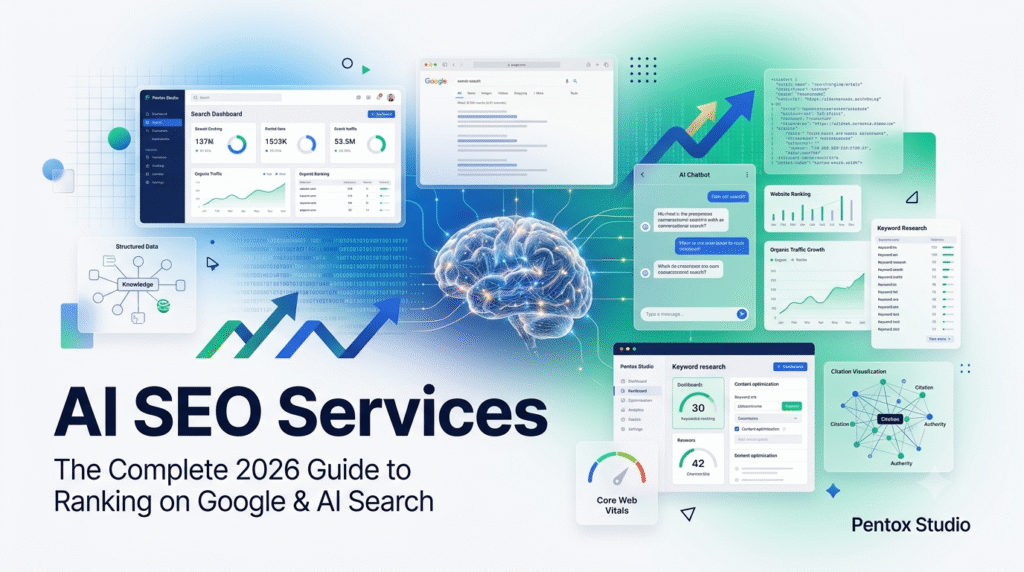
If you’ve noticed your website traffic behaving strangely this year — rankings holding steady but clicks quietly declining — you’re not imagining it. Search itself has changed shape. A meaningful share of searches now end with an AI-generated answer instead of a list of links, and the businesses that show up inside those answers are pulling ahead of the ones that don’t, regardless of where they’d rank in the old system.
This guide explains what AI SEO actually means in practice, why it matters for businesses across the US, UK, Canada, Australia, UAE, and Europe specifically, and how to build visibility for both traditional Google rankings and the AI systems now sitting above them. Pentox Studio works with businesses across several of these markets on exactly this kind of visibility, and where it’s useful we’ll reference that experience — but the goal here is a genuinely useful guide, not a pitch.
What Is AI SEO, Exactly?
| Image Title | AI Search Transformation Illustration |
| Placement | Directly under this H2 |
| AI Prompt | Flat vector illustration of a search bar transforming into a glowing neural network pattern with small citation marks around it, teal and navy palette, minimal modern style, no text, no logos. |
| ALT Text | Illustration of a search bar transforming into an AI network representing AI search optimization |
| Caption | AI SEO isn’t a replacement for SEO — it’s the same discipline, aimed at a new kind of results page. |
AI SEO — sometimes called Generative Engine Optimization (GEO) or Answer Engine Optimization (AEO) — is the practice of structuring your content and online presence so that AI-powered systems (Google AI Overviews and AI Mode, ChatGPT, Gemini, Perplexity, Claude) cite, quote, or recommend your business directly inside the answers they generate, rather than just ranking a link on a traditional results page. AI SEO services
The distinction matters: traditional SEO measures success by ranking position and clicks. AI SEO measures success by whether you’re part of the synthesized answer itself — sometimes without any click at all. Google’s own 2026 guidance describes optimizing for its AI features as still fundamentally SEO, and most credible practitioners agree: AI SEO is additive to strong SEO fundamentals, not a replacement for them. The same pillars — genuine expertise, technical health, and structured, well-organized content — matter to both traditional rankings and AI citation, just applied slightly differently.
Why This Matters Right Now, Not Eventually
This isn’t a distant future consideration. Current estimates suggest roughly 45% of online searches now involve an AI-generated answer layer somewhere in the experience, and reported click-through rate declines for purely informational search queries have been steep since AI Overviews reached full rollout. Adobe’s acquisition of Semrush in late 2025 — explicitly framed around AI visibility — put a nine-figure price tag on how seriously the broader industry now takes this shift. For a business owner, the practical takeaway is simple: if your content isn’t structured for AI systems to confidently cite, you’re increasingly invisible at exactly the research stage where customers make decisions.
SEO vs. GEO vs. AEO: Untangling the Acronyms
These terms get used inconsistently, which creates unnecessary confusion for business owners trying to make a real decision. Here’s a clean breakdown:
| Term | What It Optimizes For |
| SEO (Search Engine Optimization) | Ranking position and clicks on traditional search results |
| GEO (Generative Engine Optimization) | Being cited or quoted inside AI-generated answers (ChatGPT, Gemini, Perplexity) |
| AEO (Answer Engine Optimization) | Being the direct answer to a specific question, across both traditional snippets and AI answers |
| AI SEO (used broadly in this guide) | The combined practice of staying visible across all of the above simultaneously |
In practice, these overlap heavily enough that treating them as three separate strategies usually creates more confusion than clarity. The approach that works: build genuinely strong SEO fundamentals, then layer specific structural and authority signals on top that help AI systems specifically — which is exactly what the rest of this guide walks through.
How AI Systems Actually Choose What to Cite
| Image Title | AI Citation Selection Illustration |
| Placement | Directly under this H2 |
| AI Prompt | Flat vector illustration of several document icons with only one glowing and highlighted, connecting to a chat bubble icon, teal and navy palette, minimal clean style, no text, no logos. |
| ALT Text | Illustration of a document being selected and cited by an AI chat interface among several options |
| Caption | AI systems are surprisingly consistent about what they trust — the signals are learnable, not mysterious. |
Research into what gets cited by ChatGPT and similar systems consistently points to a few repeatable patterns, not a black box:
-
- Strong traditional SEO fundamentals — sites that already rank well organically are consistently more likely to be cited by AI systems too, since many AI search tools draw heavily on underlying search engine indexes
-
- Clear entity-based authority — AI systems favor sources that are unambiguously about a specific topic or expertise area, rather than generalist content that touches on many things shallowly
-
- Structured, extractable content — clear headings, direct answers, and logical organization make it easier for an AI system to lift a specific, accurate passage
-
- Genuine E-E-A-T signals — real author credentials, transparent business information, and demonstrated first-hand experience all feed both traditional rankings and AI trust signals
-
- External validation — brand mentions, backlinks, and third-party citations from other credible sources reinforce that your business is a trustworthy reference, not just something you claim about yourself
The Technical Foundations AI SEO Still Depends On
None of the AI-specific tactics below matter if the technical basics aren’t solid — a page an AI system can’t properly crawl or parse won’t get cited, regardless of how well-written it is.
Structured Data (Schema Markup)
Schema markup — code that explicitly tells search engines and AI systems what your content represents — has become one of the clearest, most direct authority signals available in 2026. Organization, Article, FAQPage, and Product schema (as relevant) help AI systems parse exactly what your business does and what your content means, rather than inferring it imperfectly.
Core Web Vitals and Site Health
Fast, technically healthy sites remain foundational — AI systems generally draw from content that’s already indexed and trusted through traditional search infrastructure, so the Core Web Vitals and crawlability fundamentals that mattered for classic SEO haven’t become any less important.
An llms.txt File
An emerging (optional, not yet universally adopted) standard, llms.txt is a simple file that gives AI crawlers explicit guidance about your site’s structure and key content, similar in spirit to how robots.txt guides traditional search crawlers. It’s not yet essential, but it’s a low-effort signal worth adding as adoption grows.
How to Structure Content So AI Systems Can Actually Use It
| Image Title | Content Structure for AI Illustration |
| Placement | Directly under this H2 |
| AI Prompt | Flat vector illustration of a document with clearly divided sections, each highlighted with a small extraction arrow pointing outward, teal and navy palette, minimal clean style, no text, no logos. |
| ALT Text | Illustration of a well-structured document with sections being extracted, representing AI-friendly content structure |
| Caption | AI systems reward information density and clear structure over polished but vague prose. |
-
- Front-load the direct answer — state the actual answer in the first sentence or two of a section, then elaborate afterward, rather than building up to it
-
- Keep paragraphs short — 3-4 sentences maximum in key explanatory sections; AI systems favor information density over long, meandering prose
-
- Use genuine question-and-answer formatting — phrase subheadings as the actual questions your audience asks, then answer directly underneath
-
- Use numbered lists for anything sequential — steps, processes, and rankings are the easiest format for AI systems to extract and reproduce accurately
-
- Include specific facts, figures, and named entities — vague, generic statements are far less citable than concrete, specific claims a system can quote confidently
Building Authority Signals AI Systems Trust
Brand Mentions Matter More Than They Used To
Being mentioned by name on other credible sites — even without a link back — increasingly functions as a trust signal for AI systems, which draw on a broader web of context than a single backlink graph. Digital PR, guest content, and genuine industry visibility all feed this in ways that pure backlink-building historically didn’t fully capture.
Reviews and Third-Party Validation
Consistent, genuine reviews across platforms (Google, industry-specific review sites, social proof) reinforce the same trust signals AI systems weigh when deciding whether to cite a business confidently. A business with strong, consistent third-party validation is simply easier for an AI system to recommend without hedging.
Demonstrated, Specific Expertise
Generic, could-apply-to-anyone content is the single easiest thing for both traditional Google rankings and AI systems to deprioritize. Content that demonstrates specific, first-hand expertise — real numbers, named methods, genuine nuance — consistently outperforms polished-but-generic alternatives in both contexts.
SEO Tactics vs. AI SEO Tactics: What’s the Same, What’s Different
| Tactic | Still Matters for SEO | Also Matters for AI Citation |
| Keyword research | Yes — foundational | Less directly — AI systems match intent/meaning more than exact keywords |
| Technical health & Core Web Vitals | Yes | Yes — indirectly, via traditional indexing |
| Schema markup | Helpful | Increasingly essential |
| Backlinks | Yes — core ranking factor | Yes — plus brand mentions without links |
| Content depth & E-E-A-T | Yes | Yes — arguably even more directly |
| Short, structured paragraphs | Helpful for readability | Directly affects extractability |
An Illustrative Example: Two Businesses, Two Outcomes
To make this concrete, here’s an illustrative (not client-specific) comparison of how this plays out in practice. Two competing consulting firms both rank on page one of Google for a competitive service term. Firm A’s page is well-optimized for traditional SEO — solid keywords, decent backlinks — but written in dense, marketing-style prose with no clear structure. Firm B covers the same topic with short, direct answers under clear question-based subheadings, cites specific numbers and named methods, and has consistent, genuine third-party mentions across a few industry publications.
When a prospective client asks an AI assistant to compare options in this space, Firm B is measurably more likely to be the one cited directly in the answer — not because its traditional SEO is stronger, but because its content is structured in a way the AI system can confidently extract and quote, backed by external validation the system can verify. Firm A may still rank equally well in traditional search, but increasingly loses the AI-mediated moment where many buyers now start their research.
Common Mistakes Businesses Make With AI SEO
-
- Treating AI SEO as an entirely separate discipline from SEO, rather than building on the same fundamentals
-
- Chasing every new acronym (GEO, AEO) as a distinct strategy instead of understanding the overlap
-
- Writing dense, marketing-style prose that reads well but can’t be cleanly extracted by an AI system
-
- Ignoring brand mentions and third-party validation because they don’t come with a traditional backlink
-
- Assuming AI visibility can’t be measured, and therefore not tracking it at all
Expert Tips
-
- Audit your highest-traffic pages first for AI-extractability — clear structure, direct answers, specific facts — before rewriting your entire site
-
- Manually test your own key topics in ChatGPT, Gemini, and Google AI Overviews periodically, logging whether and how your business appears
-
- Prioritize schema markup on your most commercially important pages first, not as a blanket afterthought across the whole site
-
- Don’t abandon traditional SEO fundamentals to chase AI-specific tactics — the overlap is large enough that a strong SEO foundation carries most of the weight
Advanced Strategies for 2026
| Image Title | Advanced AI Visibility Strategy Illustration |
| Placement | Directly under this H2 |
| AI Prompt | Flat vector illustration of a layered stack of platform icons — search, chat, voice — all connected to a single glowing brand icon at the center, teal and navy palette, minimal clean style, no text, no logos. |
| ALT Text | Illustration of multiple search and AI platforms connecting to a single brand, representing a unified visibility strategy |
| Caption | The strongest 2026 strategies treat every discovery surface as one connected system, not separate silos. |
-
- Build genuine digital PR relationships that generate brand mentions across multiple credible, relevant publications over time — this compounds for both SEO and AI citation
-
- Create dedicated, deeply specific resource pages around your core expertise areas rather than spreading thin across loosely related topics — entity clarity helps AI systems categorize you confidently
-
- Track AI citation manually as a specific KPI alongside traditional rankings, even without a mature automated tool — a simple spreadsheet logging prompts, platforms, and citation status works as a starting point
-
- Treat FAQ content as genuinely strategic — direct, well-structured question-and-answer content remains one of the most consistently citable formats across AI systems
-
- Diversify across SEO, GEO, and paid channels rather than betting entirely on any single discovery surface, since the search landscape is still actively shifting
Industry-Specific Considerations
| Industry | AI SEO Priority |
| Healthcare | E-E-A-T is critical — real credentials, accurate medical information, and transparent sourcing carry extra weight for both traditional and AI trust signals |
| Law Firms | Specific, jurisdiction-accurate content and demonstrated case experience outperform generic legal overviews |
| Real Estate | Local entity clarity (specific markets, neighborhoods) and current, specific data matter more than broad national content |
| SaaS / Enterprise | Structured comparison content and technical depth perform well, since B2B buyers increasingly research via AI-assisted comparison |
| E-commerce | Structured product data (schema) and genuine review signals directly affect AI shopping-assistant visibility |
How to Measure AI SEO Success
This remains the hardest part of AI SEO in 2026 — measurement tools are still maturing. Until more sophisticated tracking becomes standard, a practical approach combines a few methods: manually testing your core topics across ChatGPT, Gemini, and Perplexity on a regular schedule and logging results; monitoring referral traffic specifically from AI platforms in your analytics, which is now trackable as a distinct source in most modern analytics setups; and watching for a proxy signal — direct, branded search traffic often rises when AI-mediated citation is working, since people who encounter your brand inside an AI answer frequently search for you by name afterward.
How Pentox Studio Approaches AI SEO for International Clients
Working with businesses across multiple markets — from local Pakistani service businesses to companies in the US, UK, and UAE — has made one thing consistently clear: the fundamentals travel well across markets, but the specifics (which AI platforms matter most, local E-E-A-T expectations, industry-specific trust signals) need to be adapted per client rather than applied as a single template. Pentox Studio treats AI SEO as an extension of a strong existing SEO foundation, not a separate service sold in isolation from it.
The Future of AI SEO: What to Watch
A few developments worth tracking over the next year, without overstating certainty about any of them: standardized measurement tools for AI citation are still maturing, and the businesses that build manual tracking habits now will be ahead once better tooling arrives. Platform dynamics are also still shifting — which AI systems dominate discovery in a given market or industry can change faster than traditional search engine market share ever did, which is exactly why diversifying across SEO, AI SEO, and paid channels remains the safer strategy rather than betting heavily on any single platform’s current behavior. And regulatory and publisher relationships with AI companies are an active, evolving conversation in several markets, which could still meaningfully affect how content licensing and citation work going forward.
None of this uncertainty is a reason to wait. The fundamentals covered in this guide — technical health, genuine expertise, structured content, and real authority signals — hold up regardless of how the specific platforms and measurement tools evolve, which is exactly why building them now is a safer bet than waiting for a clearer picture that may not arrive on a convenient timeline.
Frequently Asked Questions
1. What is AI SEO?
AI SEO is the practice of structuring content and online presence so AI-powered systems like Google AI Overviews and ChatGPT cite or recommend your business directly inside their generated answers.
2. Is AI SEO different from traditional SEO?
It builds on traditional SEO rather than replacing it — strong technical health, content quality, and authority signals matter to both, with some additional structural and citation-focused tactics layered on top.
3. What is Generative Engine Optimization (GEO)?
GEO is the specific practice of optimizing content to earn citations inside AI-generated answers from tools like ChatGPT, Gemini, and Perplexity — often used interchangeably with “AI SEO.”
4. How do I get my website cited by ChatGPT?
Focus on strong underlying SEO, clear entity-based authority in your niche, structured and directly-answered content, and genuine third-party mentions and reviews that reinforce your credibility.
5. Does traditional SEO still matter in 2026?
Yes — AI systems frequently draw on the same underlying indexes and trust signals traditional SEO builds, so a strong SEO foundation remains essential rather than optional.
6. What is llms.txt?
An emerging, optional file that gives AI crawlers guidance about your site’s structure, similar in spirit to robots.txt for traditional search crawlers — not yet essential, but a low-effort signal worth adding.
7. How much does AI SEO cost?
Costs vary by scope and provider, and since AI SEO typically extends existing SEO work rather than standing alone, it’s often priced as part of a broader SEO engagement rather than a separate line item.
8. Can small businesses compete for AI citation against larger brands?
Yes, particularly in specific, well-defined niches — AI systems favor clear, specific expertise over broad brand size, which can level the playing field for smaller, more focused businesses.
9. What is E-E-A-T and why does it matter for AI SEO?
Experience, Expertise, Authoritativeness, and Trustworthiness — Google’s content quality framework — increasingly feeds AI trust signals too, since genuine expertise is what makes a source worth citing confidently.
10. How do I measure AI SEO success?
Manually test your core topics across AI platforms on a regular schedule, monitor AI-referral traffic in analytics where trackable, and watch for rising branded search as a proxy signal that citation is working.
11. Should I prioritize SEO or AI SEO first?
SEO first, since it’s the foundation AI citation largely builds on — a site with weak technical health or thin content won’t benefit much from AI-specific tactics layered on top.
12. What is schema markup and why is it more important now?
Structured data code that explicitly tells search engines and AI systems what your content represents — increasingly one of the clearest, most direct trust signals available as AI systems parse content at scale.
13. Do brand mentions without backlinks still help SEO?
Increasingly yes for AI citation specifically — AI systems draw on broader context than a single backlink graph, making unlinked brand mentions a more meaningful signal than they were historically.
14. How is AI SEO different for healthcare or legal businesses?
These industries carry extra weight on E-E-A-T specifically — real credentials, accurate information, and transparent sourcing matter even more given the sensitivity of the subject matter.
15. Is voice search part of AI SEO?
Yes — voice assistants draw heavily on the same featured snippet and AI Overview content, so structuring for direct, conversational answers benefits both.
16. How often should I check if my business is being cited by AI tools?
A regular cadence — many businesses check monthly — logging specific prompts and results, since AI citation can shift as models and training data update.
17. What content format works best for AI citation?
Direct question-and-answer formatting, numbered steps for processes, and short, information-dense paragraphs consistently perform best across AI systems.
18. Can paid advertising help if AI is reducing organic clicks?
Yes — many businesses are diversifying across SEO, AI SEO, and paid channels together rather than relying on any single discovery surface as search behavior continues shifting.
19. Will AI search eventually replace traditional Google search entirely?
Uncertain, and reasonable analysts disagree — but the practical approach regardless is building visibility across both rather than betting entirely on one outcome.
20. How does Pentox Studio approach AI SEO for international clients?
As an extension of strong existing SEO fundamentals, adapted to each market and industry’s specific trust signals rather than applied as a single uniform template.
Conclusion: Build for Both Search Experiences, Not Just One
AI SEO isn’t a separate discipline you bolt onto your marketing — it’s the natural evolution of the same fundamentals that have always mattered: genuine expertise, technical health, and content built for the reader (or, increasingly, the AI system reading on the reader’s behalf) rather than for a search algorithm alone.
The businesses pulling ahead in 2026 aren’t the ones chasing every new acronym — they’re the ones building real authority, structuring content clearly, and treating traditional SEO and AI visibility as one connected system rather than competing priorities.
Want to know where your business actually stands in AI search right now? Request a free AI search visibility audit from Pentox Studio — we’ll show you exactly how your business appears (or doesn’t) across Google, AI Overviews, and ChatGPT before recommending anything. AI SEO services