
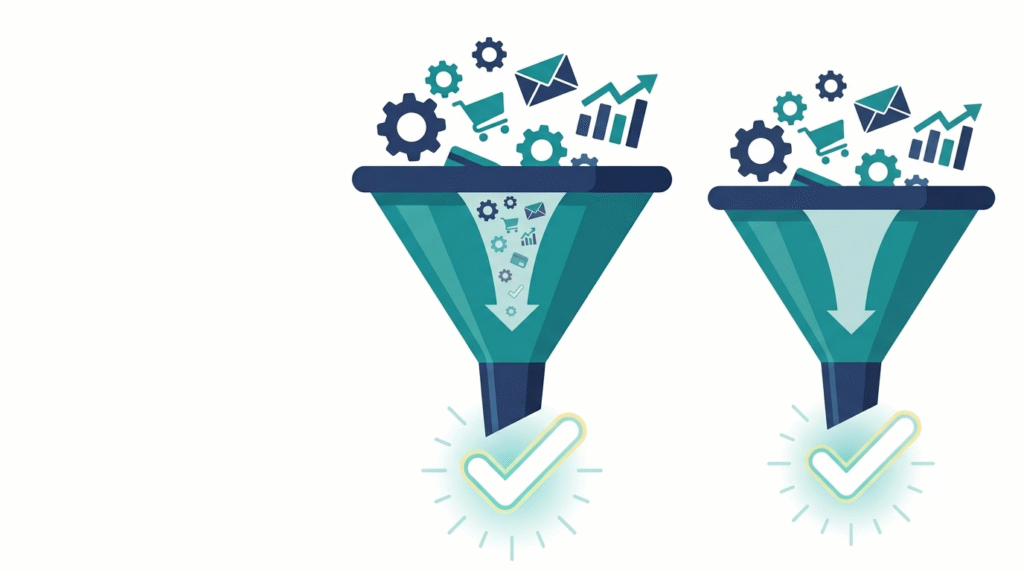
Lead Generation Strategies for Small Businesses in Pakistan: The Complete 2026 Guide
Every small business owner in Pakistan eventually hits the same wall: the work is good, the product is solid, but new customers aren’t showing up consistently enough. Word-of-mouth carries a business only so far before it plateaus — and what comes after referrals is where most businesses either figure out real lead generation, or stay stuck.
This guide breaks down exactly what lead generation means in practice, which channels actually work for Pakistani businesses in 2026 — organic, paid, and local — and how to tell a genuinely good lead from a name in a spreadsheet that never converts. Where it’s useful, we’ll point to how Pentox Studio approaches specific parts of this work, but the goal is to leave you with a real, usable strategy either way.
What Is Lead Generation, and Why It’s Different From Just “Getting Traffic”
Image Title | Lead Generation Concept Illustration |
Placement | Directly under this H2 |
AI Prompt | Flat vector illustration of a magnet pulling small figures representing potential customers toward a business icon, teal and navy palette, clean minimal style, no text, no logos, no real people depicted realistically. |
ALT Text | Illustration of a magnet attracting potential customers, representing lead generation |
Caption | Lead generation is about attracting and capturing the right interest — not just any traffic. |
Lead generation is the process of attracting potential customers and capturing enough of their information — a name, an email, a phone number, a WhatsApp message — that you can follow up and eventually turn them into a paying customer. It’s a different goal than traffic or brand awareness: a lead is someone who has taken a specific step toward becoming a customer, not just someone who happened to see your page.
This is also distinct from conversion rate optimization, which is about turning visitors you already have into leads or sales more efficiently. Lead generation is the earlier stage: making sure the right people show up in the first place, across the channels where they’re actually looking.
Marketing Qualified Leads vs. Sales Qualified Leads
Not all leads are equal, and conflating them is a common source of frustration between marketing and sales. A Marketing Qualified Lead (MQL) has shown interest — downloaded a guide, followed your page, joined a WhatsApp list. A Sales Qualified Lead (SQL) has shown real buying intent — requested a quote, booked a call, asked about pricing directly. Tracking this distinction prevents a business from either chasing vanity numbers or writing off a channel that’s actually working, just earlier in the funnel than expected.
The Lead Generation Funnel, Explained Simply
Stage | What’s Happening | Typical Content/Channel |
Top of Funnel (Awareness) | Someone discovers your business exists | SEO content, social media, guest posts |
Middle of Funnel (Consideration) | They’re comparing you against alternatives | Case studies, comparison content, reviews |
Bottom of Funnel (Decision) | They’re ready to make contact | Landing pages, quote requests, WhatsApp/call buttons |
Most lead generation problems trace back to a mismatch: pushing bottom-of-funnel “buy now” messaging at someone who just discovered you, or only publishing awareness content with no clear next step for someone ready to act.
Organic Lead Generation Channels
Image Title | Organic Growth Roots Illustration |
Placement | Directly under this H2 |
AI Prompt | Flat vector illustration of a plant with roots shaped like connected pathways leading to small customer icons, teal and navy palette, clean minimal style, no text, no logos. |
ALT Text | Illustration of roots connecting to customer icons, representing organic lead generation |
Caption | Organic lead generation takes longer to establish, but keeps producing leads without an ongoing per-lead cost. |
SEO & Local SEO
Ranking organically for the searches your potential customers are already making is one of the most durable lead generation channels available — once a page ranks, it keeps producing leads without paying per click. For location-based businesses, local SEO specifically (ranking for “[service] in [city]” and appearing in Google’s map pack) tends to produce faster, more qualified leads than broad national SEO, since the searcher’s intent is already narrowed by location.
Content Marketing
Genuinely useful content — answering the specific questions your potential customers are asking before they’re ready to buy — builds the trust that turns a stranger into a lead. This works best when content addresses real, specific problems (“how to reduce claim denials in medical billing”) rather than generic industry overviews nobody was searching for.
Google Business Profile
For any business serving a specific location, a fully optimized Google Business Profile is often the single fastest organic lead source available — free to set up, and frequently under-optimized by competitors. Complete categories, real photos, accurate hours, and active review responses all directly influence whether someone calls you or the next listing down.
Guest Posting & Backlinks
Beyond their SEO value, guest posts on genuinely relevant, well-read sites can generate direct referral leads — someone reading a guest post in their industry publication who clicks through is often a highly qualified lead, since they’re already engaged with content relevant to their specific problem.
Referral Marketing: The Channel Most Businesses Underuse Systematically
Referrals already generate leads for most small businesses, but few treat referral generation as a deliberate channel rather than something that just happens occasionally. A simple, structured referral approach — directly asking satisfied customers for introductions, offering a modest incentive for successful referrals, or making it easy to share your business (a WhatsApp-shareable link, a simple referral card) — can turn an passive channel into a genuinely predictable source of high-quality leads, since a referred lead typically arrives with a level of pre-existing trust no cold channel can replicate.
Paid Lead Generation Channels
Google Ads
Google Ads captures existing demand — someone already searching for what you offer. This makes it one of the more reliably high-intent paid channels, provided the campaign sends traffic to a landing page matching the ad’s specific promise rather than a generic homepage.
Facebook & Instagram Ads
Meta’s ad platform excels at creating demand rather than just capturing it — reaching people who haven’t searched for you yet but match a strong target audience profile. This makes it particularly effective for consumer-facing businesses (e-commerce, real estate, local services) where visual content drives interest.
Social Media Marketing (Organic + Paid Together)
A consistent organic social presence lowers the cost of paid social lead generation over time, since an audience already familiar with your brand converts at a better rate than a completely cold audience. Treating organic and paid social as connected, rather than separate efforts, tends to produce better lead quality than either alone.
Website & Landing Page Lead Capture
Traffic that doesn’t have an easy way to become a lead is wasted, regardless of which channel brought it. A few fundamentals matter more than most businesses realize:
Lead Magnets and Forms
- Offer something specific in exchange for contact information — a free audit, a checklist, a quote — not just a generic “contact us” with nothing to prompt action
- Keep forms short at the first-contact stage; every additional field measurably reduces completion rates
- Make the next step obvious immediately after form submission — a confirmation message, an expected response time, or a calendar link
WhatsApp & Click-to-Call: The Pakistan-Specific Advantage
This is worth calling out specifically because it’s often underused: WhatsApp Business is enormously popular in Pakistan, and a visible, working WhatsApp button frequently outperforms a traditional contact form for local and small businesses. It removes friction — no email, no waiting, just a direct message — and matches how many Pakistani consumers already prefer to communicate. Pairing a contact form for more formal inquiries with a prominent WhatsApp and click-to-call option covers both preferences.
B2B vs. B2C Lead Generation in Pakistan
Image Title | B2B vs B2C Channels Illustration |
Placement | Directly under this H2 |
AI Prompt | Flat vector illustration of two diverging paths, one leading to a briefcase icon and one to a shopping bag icon, teal and navy palette, clean minimal style, no text, no logos. |
ALT Text | Illustration of two paths representing B2B and B2C lead generation approaches |
Caption | The right channel mix depends heavily on whether you’re selling to a business or a consumer. |
B2B Lead Generation | B2C Lead Generation | |
Primary Channels | LinkedIn, SEO, referrals, direct outreach | Instagram, Facebook Ads, local SEO, Google Ads |
Sales Cycle | Longer, often multiple decision-makers | Shorter, often a single decision-maker |
Content That Works | Case studies, whitepapers, detailed expertise | Visual content, reviews, promotions |
Lead Volume vs. Quality | Fewer, higher-value leads | Higher volume, lower individual value |
Lead Nurturing: What Happens After You Get the Lead
Image Title | Lead Nurturing Journey Illustration |
Placement | Directly under this H2 |
AI Prompt | Flat vector illustration of a winding path with small checkpoint markers leading from a question-mark icon to a handshake icon, teal and navy palette, clean minimal style, no text, no logos. |
ALT Text | Illustration of a winding path representing the lead nurturing journey from inquiry to customer |
Caption | Getting the lead is only the beginning — most businesses lose more customers in the follow-up than in the initial contact. |
A huge share of lead generation effort gets wasted not because the leads were poor quality, but because the follow-up was slow, inconsistent, or nonexistent. Lead nurturing is the deliberate process of staying in front of a lead — with genuinely useful information, not just repeated sales pitches — until they’re ready to buy.
A Simple Lead Nurturing Sequence
- Respond within hours, not days — speed to first response is one of the strongest predictors of whether a lead converts at all
- Send a genuinely useful follow-up (answering their specific question, sharing a relevant case study) rather than an immediate hard sell
- Set a specific follow-up cadence for leads that don’t convert immediately — a week later, then monthly — rather than a single attempt and silence
- Segment leads by how they arrived and what they showed interest in, so follow-up messaging stays relevant rather than generic
For Pakistani businesses specifically, WhatsApp again plays an outsized role here — a lead who inquired over WhatsApp typically expects a faster, more conversational follow-up than one who filled out a formal contact form, and matching that expectation measurably improves close rates.
When to Stop Nurturing a Lead
Not every lead is worth nurturing indefinitely. If someone has gone cold after several genuine attempts, showed no budget alignment from the start, or was never actually a fit for what you offer, continuing to chase them wastes time better spent on leads with real potential. A simple rule: nurture consistently for a defined period (often 60-90 days), then move a non-responsive lead to a low-effort, long-term list (like an occasional newsletter) rather than either abandoning them completely or continuing high-effort outreach indefinitely.
The right channel mix shifts meaningfully depending on who you’re selling to. Here’s a realistic breakdown across the industries this guide is written for:
Industry | Best Lead Generation Channels |
E-commerce Stores | Facebook/Instagram Ads, SEO, email marketing, retargeting |
Real Estate Agencies | Local SEO, Google Business Profile, Instagram, paid social |
Law Firms | SEO, content marketing, local SEO, referral networks |
Construction Companies | LinkedIn, referrals, portfolio-driven content, local SEO |
Medical Billing Companies | LinkedIn, SEO content around compliance topics, referrals |
Truck Dispatch Companies | SEO, Facebook trucking communities, referrals |
General SMEs / Startups | A mix of local SEO, social media, and Google Ads depending on budget |
Organic vs. Paid Lead Generation: A Direct Comparison
Factor | Organic | Paid |
Speed to First Leads | Weeks to months | Hours to days |
Cost Structure | Time and content investment | Ongoing spend, stops when budget stops |
Durability | Keeps producing leads after ranking is achieved | Resets to zero without continued spend |
Best For | Long-term, compounding lead flow | Immediate pipeline gaps, launches, testing offers |
Most established businesses eventually run both together: paid channels for immediate, predictable lead flow, and organic channels building toward a lower cost-per-lead over time.
How to Measure Lead Quality, Not Just Lead Quantity
A common trap: judging a lead generation channel purely by volume. A channel producing 100 leads a month at a 2% close rate may be less valuable than one producing 20 leads a month at a 20% close rate. Track these figures specifically:
- Cost per lead (total channel spend or time investment ÷ number of leads generated)
- Lead-to-customer conversion rate, by channel — not just overall
- Average customer value by lead source, since some channels may bring smaller or larger clients
- Time from lead to close, which affects how far in advance you need to be generating leads
Without tracking these by channel, it’s easy to over-invest in whichever channel produces the most raw leads, even if it’s quietly producing the worst customers.
Common Lead Generation Mistakes
- Treating all leads as equal instead of distinguishing marketing-qualified from sales-qualified
- Running paid ads to a generic homepage instead of a landing page matching the offer
- Giving up on an organic channel before it’s had enough time to compound
- Ignoring WhatsApp and click-to-call in favor of a traditional contact form only
- Not tracking cost per lead or lead-to-customer rate by channel
- Chasing lead volume from a channel that consistently produces poor-fit customers
A Practical Lead Generation Checklist
- Define your ideal customer clearly enough to choose the right channels
- Ensure your website has a clear, low-friction way to make contact (form, WhatsApp, click-to-call)
- Fully optimize Google Business Profile if you serve a specific location
- Choose one organic and one paid channel to start, rather than spreading thin across many
- Set up basic tracking so you know which channel each lead came from
- Distinguish marketing-qualified from sales-qualified leads in how you follow up
- Review cost per lead and lead-to-customer rate monthly, by channel
Business Examples: Lead Generation in Practice
Image Title | Industry Lead Generation Examples Illustration |
Placement | Directly under this H2 |
AI Prompt | Flat vector illustration of three small distinct business icons — a shopping bag, a house, and a briefcase — each connected by a dotted line to a small funnel icon, teal and navy palette, minimal style, no text, no logos. |
ALT Text | Illustration of three business types connected to a lead funnel |
Caption | The right lead generation mix looks different depending on who you’re actually trying to reach. |
Example: An E-Commerce Store
A Lahore-based online store would typically combine Facebook and Instagram ads for immediate demand generation, SEO for product and category pages to build a lower-cost channel over time, and email marketing to re-engage past visitors and customers.
Example: A Real Estate Agency
A real estate business would typically prioritize Google Business Profile and local SEO for active property searches, paired with strong Instagram content, since buyers heavily research visually before ever making contact.
Example: A Medical Billing Company
A Karachi-based medical billing company serving US clients would typically prioritize LinkedIn outreach and SEO content demonstrating genuine compliance expertise, since the sales cycle depends on remote trust rather than volume-driven consumer channels.
Expert Tips
- Match your channel to your sales cycle — a long B2B sales cycle needs nurturing content, not just a one-time ad click
- Don’t judge a new channel too early — organic channels especially need real time before conclusions are fair
- A WhatsApp button on mobile often converts better than a form for Pakistani consumer audiences — test it directly
- Ask new customers where they found you and cross-check that against your own tracking — the two don’t always agree
A Realistic Example: Building a Lead Pipeline From Scratch
To make this concrete, here’s an illustrative (not client-specific) example of how a small service business might build its lead pipeline over a first quarter: month one focused on Google Business Profile optimization and a basic website fix; month two adding a small, targeted Google Ads test alongside the start of local SEO content; month three reviewing which channel produced the better cost-per-lead and lead-to-customer rate, then doubling down on that channel while keeping the other running at a smaller, maintenance level. This kind of deliberate, measured approach — rather than trying everything at once — tends to produce clearer answers about what actually works for a specific business.
Practical Tools for Managing Lead Generation
You don’t need an expensive enterprise stack to run this well — most small businesses in Pakistan can manage a genuinely effective lead generation system with a handful of accessible tools:
Need | Accessible Tools |
Tracking where leads come from | Google Analytics (GA4), UTM-tagged links, a simple spreadsheet log |
Managing follow-up | A basic CRM (many offer free tiers for small teams), or a well-organized spreadsheet if just starting out |
WhatsApp lead management | WhatsApp Business app (free), with saved quick replies for common questions |
Email follow-up sequences | Any mainstream email marketing platform with a free starter tier |
Local search visibility | Google Business Profile (free) and Google Search Console (free) |
The specific tools matter less than the discipline of actually using them consistently — a free spreadsheet, updated religiously, will outperform an expensive CRM nobody logs into.
How Pentox Studio Approaches Lead Generation
Rather than defaulting to a single channel, Pentox Studio typically starts by understanding a client’s sales cycle, ideal customer, and existing lead sources before recommending a channel mix — since a construction estimating firm and an e-commerce store need genuinely different strategies, not a templated package. Tracking cost per lead and lead-to-customer rate by channel is treated as standard practice, not an optional add-on, since lead volume alone rarely tells the full story.
Frequently Asked Questions
1. What is lead generation in simple terms?
The process of attracting potential customers and capturing enough of their contact information to follow up and eventually convert them into paying customers.
2. How do small businesses generate leads in Pakistan?
Most combine organic channels (SEO, Google Business Profile, content) with paid channels (Google Ads, Facebook/Instagram Ads), plus WhatsApp and referrals, matched to their specific customer type.
3. What is the difference between a lead and a customer?
A lead has expressed interest or provided contact information; a customer has actually made a purchase. Not every lead converts, which is why tracking lead-to-customer rate matters.
4. How much does lead generation cost in Pakistan?
It varies significantly by channel and industry — from minimal cost for organic and referral-based approaches to ongoing ad spend for paid channels. Cost per lead should be tracked specifically rather than estimated generally.
5. What is the best channel for lead generation?
There isn’t a single best channel — it depends on your industry, sales cycle, and budget. B2B businesses often lean toward LinkedIn and SEO; consumer businesses often lean toward social ads and local SEO.
6. How long does lead generation take to show results?
Paid channels can produce leads within days; organic channels like SEO typically take a few months to start producing consistent results, with stronger results compounding afterward.
7. What is a lead magnet?
Something specific offered in exchange for contact information — a free audit, checklist, or guide — that gives a visitor a clear reason to share their details rather than leaving anonymously.
8. How do you qualify a lead?
By assessing genuine interest and buying intent — a Marketing Qualified Lead has shown interest, while a Sales Qualified Lead has taken a concrete step like requesting a quote or booking a call.
9. What is the difference between B2B and B2C lead generation?
B2B typically involves longer sales cycles, multiple decision-makers, and channels like LinkedIn and SEO; B2C typically involves shorter cycles and channels like social ads and local SEO.
10. How do you measure lead generation success?
Track cost per lead, lead-to-customer conversion rate, and average customer value by channel — not just the raw number of leads generated.
11. Is WhatsApp actually effective for lead generation in Pakistan?
Yes, often more effective than a traditional contact form for local and consumer-facing businesses, since it matches how many Pakistani consumers already prefer to communicate.
12. Can I generate leads without spending money on ads?
Yes — SEO, Google Business Profile, content marketing, and referrals can all generate leads without direct ad spend, though they generally take longer to build than paid channels.
13. What’s a good cost per lead in Pakistan?
It varies enormously by industry and channel — there’s no universal benchmark. Tracking your own cost per lead over time, by channel, matters more than comparing to a generic number.
14. How many leads should a small business expect per month?
This depends heavily on industry, budget, and channel maturity — there’s no standard figure. Focus on consistent, measurable growth in both lead volume and lead quality over time.
15. Should I focus on lead quantity or lead quality?
Quality, ultimately — a smaller number of well-matched leads that convert at a high rate is usually more valuable than a larger number of poor-fit leads.
16. What lead generation channels work best for real estate in Pakistan?
Local SEO, Google Business Profile, and Instagram tend to perform well, since real estate buyers research visually and locally before making contact.
17. How is lead generation different from conversion rate optimization?
Lead generation is about attracting and capturing the right visitors in the first place; conversion rate optimization is about turning the visitors you already have into leads or customers more effectively.
18. Can content marketing really generate leads, or just traffic?
Content genuinely built around specific buyer questions can generate real leads directly, especially when paired with a clear next step (a form, a contact link) rather than ending with no call to action.
19. How do I choose between organic and paid lead generation first?
If you need leads within 30 days, start with paid. If you’re building for the long term and can tolerate a slower ramp-up, prioritize organic — many businesses eventually run both together.
20. How does Pentox Studio help with lead generation?
By assessing a business’s specific sales cycle and customer type before recommending a channel mix, and treating cost-per-lead and lead-to-customer tracking as standard practice rather than an afterthought.
Conclusion: Lead Generation Is a System, Not a Single Tactic
The small businesses in Pakistan that consistently win new customers aren’t relying on one clever trick — they’re running a deliberate system: the right channels for their specific customer, a low-friction way to actually capture interest, and honest tracking of which leads turn into real, paying customers.
Start small and specific rather than trying every channel at once: pick one organic and one paid approach matched to your industry, make sure your website (and your WhatsApp) makes it easy to reach you, and track cost per lead and lead-to-customer rate from day one so you know what’s actually working.
Ready to build a lead generation system for your specific business? Request a free consultation or a lead generation audit from Pentox Studio — we’ll walk through your sales cycle and customer type honestly before recommending any channel.