
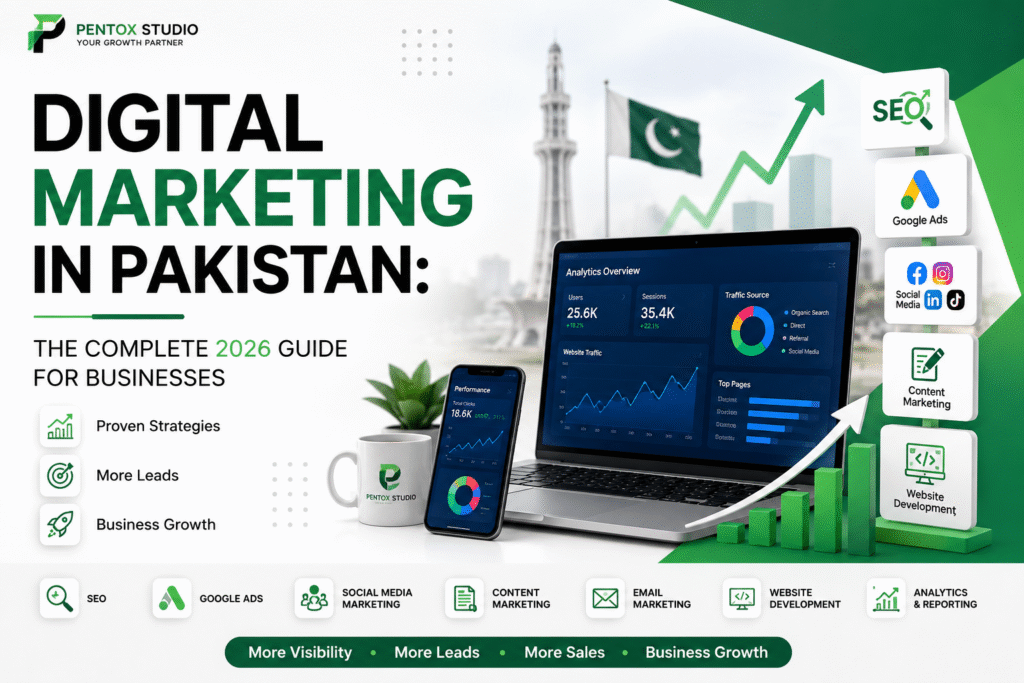
Digital Marketing in Pakistan (2026): The Complete Business Guide
If you run a business in Pakistan today — whether you sell to customers down the street or to clients in Texas and London — digital marketing in Pakistan is no longer a side project. It’s the difference between being found and being invisible. Pakistan now has roughly 117 million internet users, close to half the population, and the customers you’re trying to reach are already searching, scrolling, and comparing options online before they ever pick up a phone.
This guide walks through what digital marketing in Pakistan actually involves in 2026 — SEO, paid ads, social media, content, web development, and the AI-driven search changes reshaping all of it — written for business owners who want to understand the landscape clearly enough to make good decisions, not just buy services. Where it’s genuinely useful, we’ll point to Pentox Studio as an example of how a full-service Pakistani agency approaches this work — but the goal here is to make you a more informed buyer, not to sell you anything you don’t need.
Why Digital Marketing in Pakistan Matters Right Now
| Image Title | Pakistan Digital Growth Illustration |
| Placement | Directly under this H2, before the first paragraph |
| AI Prompt | Flat vector illustration of a stylized Pakistan map outline made of connected network nodes and small growth-chart bars rising from major city points, teal and navy color palette, clean minimal style, no readable text, no real logos or flags. |
| ALT Text | Illustration of Pakistan’s map formed from digital network nodes representing digital marketing growth |
| Caption | Pakistan’s internet economy has grown fast enough that digital marketing is now core infrastructure, not an experiment. |
A few shifts explain why this moment is different from five years ago. Internet and smartphone access have expanded into cities and towns that had almost no online commerce a decade ago. Digital payment systems and mobile wallets have made online buying dramatically easier, accelerating e-commerce across categories that used to be entirely cash-and-carry. And globally, digital ad spend is tracking toward well over a trillion dollars a year, with Pakistani businesses — and Pakistani marketing talent working remotely for international clients — increasingly part of that economy.
At the same time, the businesses still relying only on word-of-mouth and walk-in traffic are losing ground quietly. Customers now check reviews, compare a handful of options on Google or Instagram, and often decide before they ever contact a business directly. If you’re not visible at that research stage, you’re not in the running — even if your product or service is genuinely better.
Who This Guide Is For
This guide is written for a wide range of Pakistani businesses navigating digital marketing for the first time or trying to do it better: small businesses and local shops, startups and SMEs, e-commerce brands, healthcare providers and law firms, real estate companies, and — worth calling out specifically because they’re often overlooked in generic guides — the growing number of Pakistan-based service businesses built around serving international clients: medical billing companies, truck dispatching companies, construction and budget estimation firms. We’ll come back to that last group in more detail later, because their marketing needs look different from a typical local business.
What Is Digital Marketing, Exactly?
Digital marketing is the practice of promoting a business, product, or service using the internet — through search engines, social media, paid ads, email, and websites — instead of, or alongside, traditional channels like print, TV, and billboards. What makes it different from traditional marketing isn’t just the medium; it’s the measurability. Every click, view, and conversion can be tracked, which means budgets can be adjusted based on what’s actually working rather than guesswork.
For a business in Pakistan, digital marketing in practice usually means some combination of: showing up in Google search results (SEO), running paid ads on Google or Meta (PPC), building an audience on social platforms, publishing content that answers real customer questions, and having a website built to convert visitors into leads or sales. The sections below walk through each piece.
The Complete Digital Marketing Toolkit
| Image Title | Digital Marketing Toolkit Overview |
| Placement | Directly under this H2 |
| AI Prompt | Flat vector illustration of a modern toolbox opening to reveal simple icons floating above it — a magnifying glass, a chat bubble, a browser window, a paint palette — teal and navy palette, clean minimal corporate style, no text, no logos. |
| ALT Text | Illustration of a toolbox with digital marketing icons representing SEO, social media, web, and branding tools |
| Caption | Modern digital marketing is a toolkit, not a single tactic — most businesses need several pieces working together. |
Before going deep on any one channel, it helps to see the full picture. Here’s how the major pieces of digital marketing typically map to what a business needs at each stage:
| Channel | What It Solves | Best For |
| SEO & Local SEO | Long-term, compounding organic visibility | Businesses playing the long game on traffic and leads |
| Google Ads / PPC | Immediate, targeted traffic | Launches, promotions, and filling pipeline gaps fast |
| Social Media Marketing | Audience building and brand trust | Consumer brands, local businesses, e-commerce |
| Content Marketing | Authority, education, and SEO fuel | Complex products/services that need explaining |
| Website Development | The foundation everything else drives traffic to | Every business, without exception |
| Branding | Differentiation and recall | Crowded markets where trust decides the sale |
Search Engine Optimization (SEO): The Foundation
SEO is the practice of improving a website so it ranks higher in organic (unpaid) search results. In Pakistan’s market, SEO in Pakistan has matured significantly — it’s no longer just about stuffing keywords onto a page. Google now evaluates content quality, technical performance, and real-world trust signals together, which is why the sub-disciplines below all matter.
Technical SEO
Technical SEO covers everything that affects whether Google can properly crawl, index, and understand your site: site architecture, crawlability, structured data (schema markup), mobile responsiveness, and security (HTTPS). Get this wrong, and no amount of great content will rank — Google simply won’t see it correctly.
Local SEO
Local SEO focuses on ranking for location-based searches — “digital marketing agency Lahore,” “dentist near me,” “web design company Karachi.” It centers on Google Business Profile optimization, consistent NAP (name, address, phone) data across directories, and location-specific content. For any Pakistani business serving a specific city, this is often the single highest-ROI piece of SEO available.
Keyword Research
Keyword research is the process of identifying what your customers actually type into Google — the specific words and phrases, their search intent, and how competitive each one is to rank for. Good keyword research separates content that gets found from content that gets published and ignored.
Website Speed Optimization & Core Web Vitals
Core Web Vitals are Google’s specific, measurable standards for page experience — how fast the main content loads, how quickly a page responds to interaction, and how much the layout shifts while loading. In 2026, technical performance and content quality are treated as part of the same ranking signal rather than separate concerns, which means a slow, clunky website actively works against otherwise strong content.
Paid Advertising: Google Ads & PPC
| Image Title | Paid Advertising Funnel Illustration |
| Placement | Directly under this H2 |
| AI Prompt | Flat vector illustration of a simple funnel shape with a search bar icon at the top and a shopping bag icon at the bottom, coins flowing through the funnel, teal and navy palette, clean minimal style, no text, no logos. |
| ALT Text | Illustration of a marketing funnel showing paid ads converting search traffic into sales |
| Caption | Paid advertising trades budget for speed — the fastest way to put your business in front of ready-to-buy searchers. |
Google Ads
Google Ads places your business at the top of search results for keywords you choose, on a pay-per-click basis. Unlike SEO, results are immediate — your ad can appear within hours of launching a campaign — which makes it well suited to product launches, seasonal promotions, or filling a slow sales month.
PPC Management
PPC (pay-per-click) management is the ongoing work of running paid campaigns well: keyword bidding strategy, ad copy testing, landing page alignment, and budget optimization based on real conversion data. Poorly managed PPC can burn through budget fast with little to show for it — this is one area where experienced management genuinely changes the return you get per rupee spent.
Social Media Marketing That Actually Builds Audiences
Social media marketing in Pakistan has matured well beyond posting for the sake of posting. Platforms like Facebook, Instagram, TikTok, and YouTube now function as discovery engines in their own right — for many younger and mobile-first consumers, social search increasingly competes with Google as the first stop for product research.
Social Media Marketing
At its core, social media marketing means building an organic presence and community across the platforms your customers actually use — consistent posting, genuine engagement, and content formats (especially short-form video) suited to each platform’s audience.
Facebook Ads
Facebook’s ad platform (which also powers Instagram placements) remains one of the most precise targeting tools available, letting businesses reach audiences by interest, behavior, and location at a wide range of budgets — making it accessible to small businesses, not just large brands.
Instagram Marketing
Instagram marketing leans heavily on visual storytelling — Reels, Stories, and a well-curated feed — and works especially well for businesses with a genuinely visual product: fashion, food, real estate, and lifestyle brands all see strong engagement here when content quality matches the platform’s expectations.
Content, Email & Authority Building
| Image Title | Content and Authority Building Illustration |
| Placement | Directly under this H2 |
| AI Prompt | Flat vector illustration of an open book merging into a network of connected link icons and an envelope, teal and navy palette, clean minimal corporate style, no text, no logos. |
| ALT Text | Illustration of a book and network links representing content marketing and authority building |
| Caption | Content and authority-building work together: good content earns the links and trust that search engines and readers both reward. |
Content Marketing
Content marketing means creating genuinely useful material — blog posts, guides, videos — built around what your customers are actually searching for, rather than what’s convenient to write. Done well, it feeds SEO, gives social media something worth sharing, and builds the kind of expertise signal Google increasingly rewards.
Email Marketing
Email marketing remains one of the highest-ROI channels available precisely because it isn’t dependent on any platform’s algorithm — you own the list. For Pakistani e-commerce and service businesses, a well-run email sequence (welcome series, abandoned cart recovery, regular value-driven newsletters) often outperforms paid channels on a pure cost-per-result basis.
Guest Posting
Guest posting means publishing content on other relevant, reputable websites in exchange for a link back to your own site. Done properly — on real sites with genuine readerships, in relevant niches — it builds both referral traffic and search authority. Done carelessly, on spammy link farms, it can do real damage instead.
Link Building
Link building is the broader practice of earning backlinks from other websites, treated by search engines as a vote of confidence in your site’s trustworthiness. It’s slower and more relationship-driven than most other channels, which is exactly why it’s one of the harder ones to fake convincingly — and one of the most valuable when done right.
Website Development, Design & Branding
Website Development
Website development is the technical build of your site — the code, functionality, and infrastructure that make it fast, secure, and reliable. This is the foundation every other channel depends on: an ad campaign driving traffic to a broken or slow site is money spent for nothing.
Website Design
Website design is the user-facing side — layout, visual hierarchy, and user experience that determines whether a visitor understands what you offer and takes action, or leaves within seconds. Good design is measured in conversions, not just aesthetics.
Branding
Branding is the consistent identity — visual, verbal, and experiential — that makes your business recognizable and trusted over time. In crowded Pakistani markets where price competition is intense, strong branding is often the deciding factor between two similarly priced options.
Lead Generation & Conversion Rate Optimization
Lead Generation
Lead generation is the process of capturing interest from potential customers — through forms, calls, WhatsApp inquiries, or downloads — before they’re ready to buy outright. Every channel above ultimately feeds into this: traffic that doesn’t convert into a lead or sale isn’t delivering business value, regardless of how impressive it looks in a report.
Conversion Rate Optimization (CRO)
CRO is the practice of systematically improving the percentage of visitors who take a desired action — filling out a form, making a purchase, booking a call — through testing changes to page layout, copy, and calls-to-action. It’s often the most overlooked, highest-leverage discipline in digital marketing: improving conversion rate makes every other channel’s traffic more valuable, without spending an extra rupee on acquisition.
AI Marketing & Google AI Search in 2026
| Image Title | AI Search Transformation Illustration |
| Placement | Directly under this H2 |
| AI Prompt | Flat vector illustration of a search bar transforming into a glowing neural-network pattern with small chat-bubble icons around it, teal and navy palette, minimal modern style, no text, no logos. |
| ALT Text | Illustration of a search bar transforming into an AI network representing AI-driven search in 2026 |
| Caption | Search itself has changed shape in 2026 — AI-generated answers now sit above traditional results for a growing share of queries. |
This is the single biggest shift in digital marketing right now, and it’s worth understanding in concrete terms rather than as vague hype. In May 2026, Google made AI Mode — its conversational, AI-generated search experience — the default way people search worldwide, running on a newer model and reportedly already used by more than a billion people monthly. AI Overviews (the AI-written summaries that appear above traditional results) now show up on a meaningful and fast-growing share of searches.
This has real, practical consequences. Zero-click searches — where a user gets their answer directly on the results page without visiting any website — now account for a majority of all Google searches. Click-through rates on the traditional top organic result have measurably declined as a result. At the same time, Google has folded its Helpful Content standards directly into core ranking rather than treating them as a separate filter, meaning genuinely useful, well-structured content matters more for both traditional rankings and AI-generated answers, not less.
One specific, recent change worth knowing if you’re publishing content: Google removed the expandable FAQ rich results (the Q&A dropdowns that used to appear directly in search listings) in May 2026 across all site types. FAQPage schema markup is still worth using — it helps Google and AI systems understand your content structure — but don’t expect it to produce the visual FAQ dropdown in search results the way it once did.
What This Means Practically for Pakistani Businesses
- Content needs to be genuinely citable — clear, well-structured, and specific enough that an AI system would want to reference it directly.
- Brand mentions and off-site signals (reviews, digital PR, real community discussion) now feed AI-generated answers, not just traditional rankings.
- Content freshness matters more — pages with recent, visible updates consistently outperform stale content in both traditional and AI search.
- Measuring success purely by keyword rankings is increasingly incomplete — visibility inside AI Overviews and branded search growth are becoming equally important signals to track.
AI Marketing & Marketing Automation
Beyond search itself, AI marketing tools are changing how campaigns get built and managed day to day — from AI-assisted ad copywriting and audience targeting to chatbots handling initial customer inquiries around the clock. Marketing automation platforms now handle much of the repetitive work (email sequences, lead scoring, follow-up messaging) that used to consume hours of manual effort, freeing budget toward strategy and creative work that’s harder to automate well.
The Digital Marketing Industry in Pakistan: A 2026 Snapshot
Pakistan’s digital marketing industry has grown quickly, but unevenly. On one hand, demand for digital marketing services in Pakistan is at an all-time high, driven by e-commerce growth, rising smartphone penetration, and businesses across nearly every sector recognizing that a digital presence is no longer optional. On the other hand, the industry still faces real friction: many small businesses remain unaware of what’s actually possible, budgets are often set arbitrarily rather than tied to realistic goals, and there’s a persistent shortage of specialists who go deep in one discipline rather than claiming to do everything at once.
The upside for business owners: this gap means genuinely skilled, transparent digital marketing partners stand out quickly in Pakistan’s market, precisely because inconsistent quality is still common. It also means Pakistan has become a significant source of remote digital marketing talent for international clients — with skilled Pakistani marketers increasingly working directly with US, UK, and European businesses through platforms built for global freelance and agency work.
Digital Marketing for Pakistan’s Niche B2B Service Exporters
Most digital marketing guides for Pakistan focus entirely on local businesses selling to local customers. That leaves out a genuinely large and fast-growing segment: Pakistan-based companies built specifically to serve international clients — medical billing companies, truck dispatching companies, construction estimating and budget estimation firms among them. These businesses have fundamentally different marketing needs, and it’s worth addressing them directly.
| Image Title | B2B Service Export Illustration |
| Placement | Directly under this H2, before the table |
| AI Prompt | Flat vector illustration of a globe with dotted connection lines linking Pakistan to the US and UK, small icons around the lines representing documents, a truck, and a building blueprint, teal and navy palette, minimal style, no text, no real flags or logos. |
| ALT Text | Illustration of a globe with connections between Pakistan and international markets representing B2B service exports |
| Caption | Medical billing, truck dispatching, and construction estimating firms in Pakistan sell almost entirely to clients they’ll never meet in person — marketing has to do the trust-building a handshake normally would. |
What these businesses have in common: their buyers are almost entirely in the US, Canada, or UK; the sales cycle depends heavily on trust and credibility since the relationship is fully remote; and generic “digital marketing agency” content rarely speaks to their actual challenges. Here’s what tends to matter most for each:
| Industry | What Drives Their Marketing | Priority Channels |
| Medical Billing Companies | Compliance credibility (HIPAA-aware messaging), case studies with US healthcare clients | LinkedIn, SEO for niche terms, referral-driven content |
| Truck Dispatching Companies | Trust signals for US-based owner-operators, clear service explanations | SEO, Google Ads, Facebook groups for trucking communities |
| Construction & Budget Estimation Firms | Portfolio proof, turnaround-time messaging, accuracy guarantees | LinkedIn, SEO, direct outreach & guest content in construction publications |
| Real Estate Companies | Local visibility plus polished visual listings | Local SEO, Instagram, Google Business Profile, paid social |
| Healthcare Businesses | Trust, accuracy, and E-E-A-T-aligned content | Local SEO, content marketing, reputation management |
| Law Firms | Authority and demonstrated expertise | SEO, content marketing, LinkedIn, local search |
The common thread: for businesses selling trust to clients they’ll likely never meet face-to-face, a professional website, credible case studies (even anonymized), and genuinely authoritative content matter disproportionately more than volume-based tactics. This is one of the areas where working with an agency that has actually handled international-facing clients — as Pentox Studio has across several of these exact verticals — tends to save businesses from expensive trial and error.
How to Choose a Digital Marketing Partner in Pakistan
Whether you handle marketing in-house, hire a freelancer, or bring on an agency depends mostly on your budget, how much time you have to manage the work, and how complex your needs are. Here’s a straightforward comparison:
| In-House / DIY | Freelancer | Full-Service Agency | |
| Cost | Lowest direct cost, highest time cost | Moderate | Higher, but bundled |
| Speed to Start | Slow (learning curve) | Fast | Fast |
| Range of Skills | Limited to what you know | Usually one specialty | Full team across channels |
| Best For | Very simple, low-competition niches | One specific channel need | Businesses needing multiple channels working together |
Questions Worth Asking Before You Hire Anyone
- Can you show real case studies or examples relevant to my industry?
- What exactly is included in this price, and what counts as extra?
- How will you report progress, and how often will we actually talk?
- Who specifically will work on my account day to day?
A transparent agency will answer all of these directly and specifically. Pentox Studio, for example, structures every new engagement around an initial audit and a clear scope before any proposal goes out — a pattern worth expecting from any agency you’re evaluating, not just this one.
Digital Marketing Readiness Checklist
Before investing significantly in any channel, most Pakistani businesses benefit from getting these fundamentals in place first:
- A fast, mobile-friendly website with clear calls-to-action
- Google Business Profile fully set up and verified (for any location-based business)
- Basic keyword research done for your core services, even informally
- At least one active social platform matched to where your customers actually spend time
- A simple way to capture leads — a contact form, WhatsApp Business, or booking link
- Analytics installed (Google Analytics and Search Console, at minimum) so results are actually measurable
- A clear sense of your monthly budget and realistic goals before contacting any agency or freelancer
Expert Tips
A few practical notes worth keeping in mind, regardless of which channels you invest in first:
- Don’t chase every platform at once — one channel done well outperforms five done halfheartedly.
- Track leads and revenue, not just traffic and followers — vanity metrics feel good but don’t pay bills.
- Refresh your best-performing content periodically — a stale page loses ground even if nothing else changed.
- If a provider guarantees specific rankings or overnight results, treat it as a warning sign, not reassurance.
Business Examples: What This Looks Like in Practice
| Image Title | Business Growth Examples Illustration |
| Placement | Directly under this H2 |
| AI Prompt | Flat vector illustration of two small storefront and office icons side by side, each with a small upward arrow graph above it, connecting lines suggesting online growth, teal and navy palette, minimal clean style, no text, no logos. |
| ALT Text | Illustration of two businesses with upward growth arrows representing digital marketing success |
| Caption | The specific mix of channels looks different depending on who the customer actually is — local shopper or international client. |
To make this concrete, here are two illustrative (not client-specific) examples of how the channel mix above tends to play out in practice:
Example: A Local E-Commerce Brand
A Lahore-based fashion brand selling primarily to local customers would typically prioritize Instagram marketing and paid social ads for visual discovery, local SEO and Google Business Profile for anyone searching by location, and email marketing for repeat purchases — with a fast, mobile-optimized website tying it all together.
Example: A B2B Service Exporter
A Karachi-based medical billing company serving US healthcare clients would typically prioritize a credible, professional website with clear compliance messaging, LinkedIn for direct outreach and credibility, targeted SEO content addressing specific US healthcare-billing search terms, and case studies (even anonymized) that build the trust a fully remote relationship depends on.
Frequently Asked Questions
1. What is digital marketing in Pakistan, in simple terms?
It’s promoting a business online — through search engines, social media, ads, and content — to reach customers who are already researching and buying online rather than relying only on foot traffic or word-of-mouth.
2. How much does digital marketing cost in Pakistan?
Costs vary widely by service and provider, typically ranging from tens of thousands of rupees per month for a single channel to significantly more for full-service, multi-channel management. Get a scoped quote based on your specific goals rather than relying on a single average figure.
3. Is SEO or Google Ads better for a new business?
They solve different problems. Google Ads brings traffic immediately but stops when you stop paying; SEO takes longer to build but keeps generating traffic without an ongoing per-click cost. Many new businesses run both together.
4. How long does SEO take to show results in Pakistan?
Most businesses see early movement within 3 months, with stronger, compounding results by month 6–12, depending on competition and the site’s starting condition.
5. Do I need a website if I only sell through social media?
Yes, in most cases. A website adds credibility, gives you a channel you fully control (unlike a social platform), and captures customers who prefer searching Google over browsing Instagram.
6. What is local SEO and do I need it?
Local SEO helps your business appear in location-based searches and Google’s map pack. If you serve customers in a specific city or area, it’s typically one of the highest-return investments available.
7. Can small businesses in Pakistan afford digital marketing?
Yes — most channels scale to different budget levels. A small business might start with Google Business Profile optimization and organic social media before adding paid channels as revenue allows.
8. What is AI Overview and how does it affect my business’s visibility?
AI Overviews are AI-generated answer summaries that now appear above traditional Google results for many searches. They make clear, well-structured, genuinely helpful content more important, since AI systems favor content they can confidently cite.
9. Should I hire a freelancer or an agency?
A freelancer often suits a single, well-defined need; an agency suits businesses needing multiple channels working together under one coordinated strategy. Budget and complexity should drive the decision.
10. What industries in Pakistan benefit most from digital marketing?
Virtually all of them, but e-commerce, healthcare, real estate, law, and B2B service exporters (like medical billing and truck dispatching companies) see particularly strong returns given how much their buyers now research online first.
11. What is the difference between SEO and PPC?
SEO earns organic (unpaid) rankings over time through optimization and content; PPC (pay-per-click) buys immediate placement through paid ads. They’re complementary, not competing, strategies.
12. How important is social media marketing for B2B companies?
Less about direct sales and more about credibility — particularly LinkedIn, where consistent, professional presence builds trust with international clients evaluating a Pakistan-based partner.
13. What is Core Web Vitals and why does it matter?
It’s Google’s measurable standard for page speed and user experience. Poor Core Web Vitals scores can hold back rankings even when your content itself is strong.
14. Is guest posting still effective for SEO in 2026?
Yes, when done on genuinely relevant, reputable sites with real readerships. Guest posts on low-quality link farms can do more harm than good.
15. How do I measure if my digital marketing is working?
Track leads, conversions, and revenue attributable to each channel — not just traffic or follower counts. Google Analytics and Search Console are the minimum tools needed to see this clearly.
16. What is marketing automation and do I need it?
It’s software that handles repetitive marketing tasks — email sequences, lead follow-up, basic customer replies — automatically. Worth adopting once you have enough volume that manual handling starts costing real time.
17. Can digital marketing help a law firm or healthcare business in Pakistan?
Yes, particularly through local SEO, authoritative content, and reputation management — trust-driven fields where a strong, credible online presence directly influences whether a prospective client reaches out.
18. What’s the biggest digital marketing mistake Pakistani businesses make?
Spreading effort too thin across every platform at once instead of doing one or two channels well, and not measuring results in a way that ties back to actual leads or revenue.
19. How is AI changing digital marketing in Pakistan?
AI is reshaping both how customers search (AI Overviews, conversational search) and how marketers work (AI-assisted content, automation, and targeting) — making adaptability more important than any single fixed strategy.
20. How do I get started with digital marketing for my business?
Start with the fundamentals: a solid website, Google Business Profile if you’re location-based, and one social platform matched to your customers — then add SEO, paid ads, or content based on your specific goals and budget.
Conclusion: Building a Digital Presence That Actually Works
Digital marketing in Pakistan has moved well past the point of being optional — but that doesn’t mean every business needs every channel at once. The businesses that succeed are the ones that get the fundamentals right first, choose channels that match how their specific customers actually search and buy, and measure results honestly enough to know what’s working.
Whether that means a local shop finally setting up Google Business Profile properly, a healthcare practice investing in genuine content authority, or a medical billing company building the credibility a fully remote client relationship depends on — the principles are the same: clarity on goals, patience with channels that compound over time, and a partner (in-house, freelance, or agency) who’s transparent about what they’re actually doing and why.
Not sure where to start? Pentox Studio offers a free initial audit for businesses across Pakistan and internationally — a clear, no-obligation look at where your digital presence stands today and what would actually move the needle.