
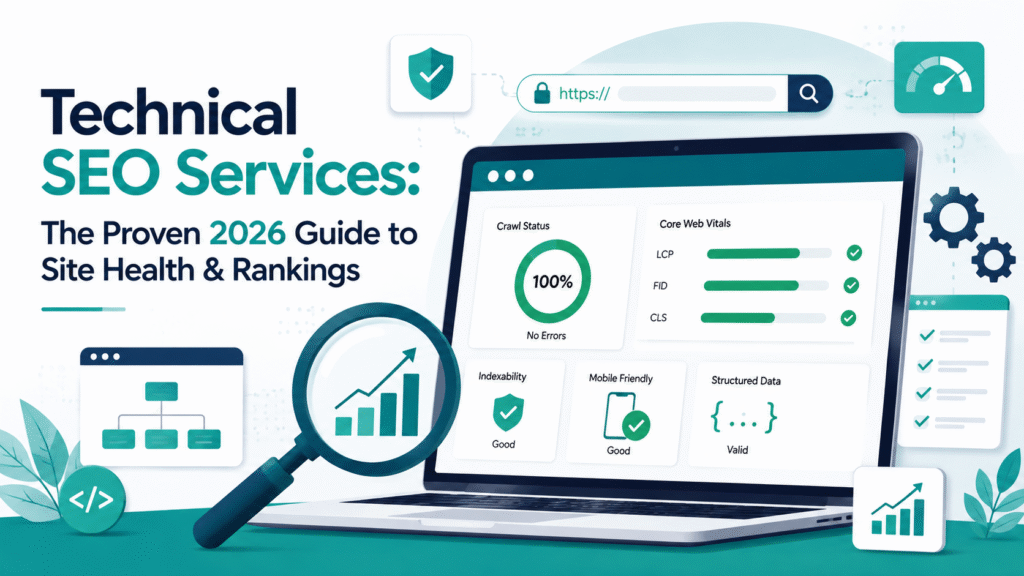
Here’s a number worth sitting with: organic search leads close at 14.6%, compared to 1.7% for outbound marketing leads, at a cost per lead of roughly $147 versus $280 for paid search. Technical SEO is the foundation that determines whether your business even gets the chance to capture that advantage, because none of it matters if Google, Bing, or an AI crawler cannot properly access, render, and trust your site in the first place. Technical SEO is not a checklist item to tick off once. It is the infrastructure everything else, content, backlinks, brand, is built on top of.
This guide covers what technical SEO actually requires in 2026, Core Web Vitals as they currently stand, crawlability and indexation, the rapidly growing importance of AI crawler access, industry-specific priorities, and a practical framework for prioritizing fixes by business impact rather than working through a generic checklist top to bottom. Pentox Studio treats technical SEO as the starting point of every client engagement, whether the project is a technical audit on an existing site or a new build, and where it’s useful we’ll reference that directly throughout.
The Real Business Case for Technical SEO
| Image Title | Technical Foundation Business Impact Illustration |
| Placement | Directly under this H2 |
| AI Prompt | Flat vector illustration of a website structure represented as a building foundation with a growth chart rising above it, teal and navy palette, minimal clean style, no text, no logos. |
| ALT Text | Illustration of a website foundation supporting a rising growth chart representing technical SEO’s business impact |
| Caption | Technical SEO isn’t glamorous, but it’s the foundation every other marketing investment stands on. |
Most technical SEO content leads with the mechanics, Core Web Vitals thresholds, crawl budgets, schema types, and treats the business case as an afterthought. That is backwards for anyone deciding whether to actually invest in this. The real numbers make the case directly: organic traffic still captures roughly 53% of all trackable digital traffic globally, and in the competitive B2B SaaS sector, disciplined SEO Services investment shows an average three-year ROI of 702%. E-commerce sites that bring their Core Web Vitals up to good thresholds report 15-30% conversion rate improvements and 12-20% organic traffic increases, not eventually, as a direct, measurable result of the technical fix itself.
Why This Matters More Than It Used To
- Roughly 45% of all websites currently fail to meet baseline Core Web Vitals standards, meaning technical health is now a genuine competitive differentiator, not just table stakes
- 67% of enterprise and mid-market websites suffer from orphaned pages, content that exists but is functionally invisible to search engines
- AI crawlers now make up roughly 22% of all bot traffic hitting websites, and most of them do not execute JavaScript, a technical reality most businesses haven’t accounted for yet
- A 10-second load time increases bounce probability by 123% compared to a 1-second load time, a direct, immediate cost of poor technical health
Core Web Vitals in 2026: What Actually Changed
| Image Title | Core Web Vitals Dashboard Illustration |
| Placement | Directly under this H2 |
| AI Prompt | Flat vector illustration of three circular gauge meters side by side, each showing a different performance metric, teal and navy palette, minimal clean style, no text, no logos. |
| ALT Text | Illustration of three gauge meters representing Core Web Vitals metrics |
| Caption | Only 54.6% of active websites currently meet baseline Core Web Vitals standards. |
| Metric | What It Measures | Good Threshold |
| Largest Contentful Paint (LCP) | Loading performance, how quickly the largest visible content element renders | Under 2.5 seconds |
| Interaction to Next Paint (INP) | Responsiveness, how quickly the page responds to user interaction (replaced First Input Delay) | Under 200 milliseconds |
| Cumulative Layout Shift (CLS) | Visual stability, how much visible content unexpectedly shifts during loading | Under 0.1 |
Only 54.6% of active websites currently meet baseline Core Web Vitals standards, with mobile lagging noticeably behind desktop, roughly 36% of mobile sites pass among the top one million websites, compared to 48% of desktop versions. Given that over 63% of web traffic now comes from mobile devices, this gap is a genuine, quantifiable competitive opportunity for any business willing to invest the technical attention its competitors haven’t.
Crawlability and Indexation: Making Sure You Can Even Be Found
If a page cannot be accessed or indexed, it cannot rank, and it cannot be used in an AI-generated answer either. This is the most foundational layer of Technical SEO, and it is also where a genuinely large share of sites quietly lose visibility without ever realizing why.
Crawl Budget
Crawl budget refers to how often and how extensively search engines crawl a given website. For large or frequently updated sites, this becomes a real constraint, wasted crawl activity on thin, duplicate, or outdated pages means important pages get crawled less often, or not at all. Eliminating waste (removing, redirecting, or properly tagging low-value pages) is the starting point for optimizing it.
Robots.txt, Noindex, and Canonical Tags
- Robots.txt guides crawler behavior, indicating which areas of a site should or shouldn’t be accessed, though it doesn’t directly control indexing on its own
- Noindex tags are explicit, telling search engines not to include a specific page in results, useful for duplicate, thin, or temporary content
- Canonical tags resolve duplication by indicating the preferred version of a page, consolidating authority signals rather than diluting them across near-identical URLs
- 67% of enterprise and mid-market websites suffer from orphaned pages, content with no internal links pointing to it, effectively invisible to crawlers regardless of its own quality
Mobile-First Indexing and Security Baselines
Search engines now evaluate over 70% of all global websites exclusively through mobile-first indexing, meaning the mobile version of a page, not the desktop version, is what actually gets crawled and ranked in most cases. Mobile responsiveness and HTTPS security are no longer competitive advantages, they are baseline expectations. Failing either doesn’t help you stand out; it actively limits visibility regardless of how strong the rest of your site is.
AI Crawler Access: The Technical Shift Most Businesses Haven’t Made Yet
| Image Title | AI Crawler Access Illustration |
| Placement | Directly under this H2 |
| AI Prompt | Flat vector illustration of a website document with two separate robot-icon crawlers accessing it, one labeled with a search icon and one with a chat bubble icon, teal and navy palette, minimal clean style, no text, no logos. |
| ALT Text | Illustration of two different crawler types accessing a website, representing traditional search and AI crawlers |
| Caption | A site can rank on page one of Google and still be invisible to ChatGPT, for entirely technical reasons. |
AI crawlers now make up roughly 22% of all bot traffic hitting websites, and this is where a real, current gap opens up: a page can pass every Core Web Vital and rank on page one of Google, and still never surface in ChatGPT, Perplexity, or Gemini, for a purely technical reason. Most AI crawlers do not execute JavaScript. If your content, pricing, or key claims are rendered client-side rather than present in the initial HTML, traditional search engines with improved rendering capabilities might still find it, but most AI crawlers simply won’t.
What This Means Practically
- Server-side rendering (SSR) is the safer approach for any content you need both traditional search engines and AI crawlers to reliably access
- A technical audit in 2026 needs to explicitly check what content is visible in raw HTML versus only rendered after JavaScript executes
- Consider an llms.txt file, similar in spirit to robots.txt but specifically for AI crawlers, to help manage visibility and attribution within AI-driven experiences, alongside, not instead of, your existing robots.txt
- Schema markup has become genuinely important infrastructure here, not just a rich-results nice-to-have, structured data helps AI systems parse and correctly attribute your content
Structured Data as AI Infrastructure
Schema markup adoption has matured steadily since Google began rewarding it with rich results, but its role has expanded well beyond that original purpose. In 2026, structured data is a primary signal AI systems draw on to understand exactly what a page represents, an organization, a product, an article, a local business, a set of FAQs, rather than inferring it purely from unstructured text. This overlaps directly with the entity clarity work behind strong Technical SEO and Content Marketing, both benefit from the same clean, accurate structured data foundation.
JavaScript Rendering: Still Complicated, Now Higher Stakes
JavaScript is ubiquitous on the modern web, and its relationship with SEO remains genuinely complex. Google has improved its rendering capabilities significantly, but server-side rendering is still the recommended approach for any page where ranking reliability actually matters, since rendering delays and failures still occur even with modern crawlers. For AI bots specifically, the situation is more clear-cut: most simply do not execute JavaScript at all, making this less a nuanced trade-off and more a binary access question for AI-driven visibility.
Site Architecture and Internal Linking
A logical site hierarchy does two jobs at once: it distributes link equity to your most important pages, and it reinforces topical relevance so search engines and AI systems understand which pages matter most on a given subject. This is where Web Design & Development and Technical SEO genuinely overlap, a site’s information architecture is a design decision with direct technical SEO consequences, not two separate concerns handled by two separate teams.
- Keep important pages within a small number of clicks from the homepage, deep, buried pages receive less crawl attention and weaker authority signal
- Use descriptive, keyword-relevant anchor text for internal links, rather than generic click here or read more phrasing
- Regularly audit for orphaned pages, content that exists but has no internal links pointing to it, and either link to it properly or remove it
Technical SEO for International and Multi-Region Websites
| Image Title | International Technical SEO Illustration |
| Placement | Directly under this H2 |
| AI Prompt | Flat vector illustration of a website document connected to several small country outline icons by thin lines, each with a small gear icon representing technical configuration, teal and navy palette, minimal clean style, no text, no logos, no real flags. |
| ALT Text | Illustration of a website connected to multiple country markets with technical configuration icons |
| Caption | International sites carry every domestic technical requirement, plus an entirely additional layer. |
Businesses targeting the USA, UK, Canada, Australia, and European markets simultaneously carry an additional technical layer on top of everything above. Hreflang implementation errors are extremely common, and they compound the crawlability and indexation issues already covered here, a page with a broken hreflang cluster can end up with search engines unsure which country version to serve, weakening both versions rather than strengthening either. This connects directly to the International SEO and Technical SEO work Pentox Studio treats as one combined discipline for clients expanding across markets, since the technical foundation and the international targeting strategy have to be correct together, not sequenced as separate projects.
- Verify hreflang tags are reciprocal and don’t conflict with canonical tags, a common technical failure specific to multi-region sites
- Confirm XML sitemaps are properly segmented by country or language version, rather than one undifferentiated sitemap covering every market
- Check that Google Search Console’s international targeting settings, where applicable, match the actual site structure
Industry-Specific Technical SEO Considerations
Technical SEO priorities shift meaningfully depending on business type, applying a generic checklist evenly across an e-commerce catalog, a SaaS product site, and a local service business wastes effort on the wrong fixes for each.
| Business Type | Primary Technical Priority |
| E-commerce | Faceted navigation and filter URLs generating near-duplicate content at scale; product page Core Web Vitals directly tied to conversion |
| SaaS / software | JavaScript-heavy interfaces requiring server-side rendering for key marketing and pricing pages; structured data for software application schema |
| Local / service business | Location page indexation and NAP consistency; mobile Core Web Vitals, since local search traffic skews heavily mobile |
| Publishers / content sites | Crawl budget efficiency at scale; internal linking depth across a large, frequently growing archive |
Prioritizing Fixes by Business Impact, Not Checklist Order
A complete technical SEO audit typically reveals 10-30 prioritized issues, and the mistake most businesses make is working through them in whatever order a tool lists them, rather than by actual business impact. Not every issue deserves equal urgency.
| Priority | Issue Type | Why It’s Urgent |
| Critical | Pages blocked from indexing, broken canonical tags, major crawl errors | Directly prevents ranking regardless of content quality |
| High | Failing Core Web Vitals on high-traffic pages, missing mobile optimization | Directly affects conversion and user retention on pages already getting traffic |
| Medium | Orphaned pages, thin content, missing structured data | Limits growth potential but doesn’t actively damage current performance |
| Lower | Minor schema gaps, non-critical image optimization | Worth fixing, but shouldn’t delay higher-impact work |
Step-by-Step: Running a Technical SEO Audit
- Run Core Web Vitals diagnostics (PageSpeed Insights and Chrome User Experience Report data) for both mobile and desktop separately, since they frequently show meaningfully different results
- Check crawl budget usage and identify blocked or non-indexed pages that should be visible
- Verify JavaScript rendering via Search Console’s URL Inspection tool, and separately check what is visible in raw HTML for AI crawler purposes
- Map internal link depth and identify orphaned pages with no internal links pointing to them
- Review Search Console’s Mobile Usability report for mobile-specific issues
- Validate structured data using Google’s Rich Results Test
- Audit for duplicate content and confirm canonical tags are implemented correctly across the site
- Prioritize findings by business impact using the framework above, not by the order a scanning tool happens to list them
Common Mistakes in Technical SEO
- Treating a technical SEO audit as a one-time project rather than an ongoing discipline, technical health degrades as sites grow and change
- Fixing low-impact issues first because they’re easier, while critical indexation blockers sit unresolved
- Optimizing exclusively for traditional search crawlers while ignoring that AI crawlers largely cannot execute JavaScript at all
- Treating mobile as a secondary concern when mobile-first indexing means it is now often the primary version search engines actually evaluate
- Never revisiting orphaned pages, silently losing search visibility on content that may have taken real time and budget to produce
Best Practices
- Pair Technical SEO fixes with Web Design & Development decisions from the start of any new site build, rather than auditing technical health only after launch
- Use Content Marketing and structured data together, well-organized, clearly marked-up content is easier for both search engines and AI systems to parse and trust
- Common tools for ongoing monitoring include Screaming Frog and SEMrush for crawl analysis, alongside Google Search Console and PageSpeed Insights for performance data
- Re-audit quarterly at minimum, and immediately after any significant site redesign or platform migration, since these are the moments technical issues are most likely to be introduced
Illustrative Case Study: The Cost of Deferred Technical Work
To make this concrete, here is an illustrative, not client-specific, example. A mid-size B2B services company had invested heavily in content for over a year, publishing consistently, with genuinely strong writing. Rankings stayed flat regardless. A technical audit found the culprit: roughly a third of their blog content sat on orphaned pages with no internal links pointing to them at all, and their core service pages failed Core Web Vitals on mobile specifically, where the majority of their traffic actually arrived.
Fixing the internal linking structure and bringing mobile Core Web Vitals to passing thresholds, without producing a single new piece of content, produced a measurable ranking and traffic improvement within the following quarter. The content had been good the entire time. The technical foundation underneath it had not been.
The broader lesson generalizes well beyond this one example: content and technical health are not competing budget priorities, they’re sequential dependencies. Content quality determines the ceiling on performance once a page is properly accessible; technical health determines whether that ceiling is ever reachable in the first place. Businesses that treat technical SEO as optional overhead, rather than as the prerequisite it actually is, consistently underperform their actual content quality in search results.
What to Expect: Technical SEO Services Pricing
Since this article carries genuine commercial intent, it’s worth addressing directly rather than leaving it implied. Technical SEO pricing varies significantly based on site size and complexity, but a few general patterns hold across the industry.
- A one-time technical SEO audit for a small to mid-size business site typically runs as a fixed-scope engagement, with pricing driven primarily by site size and the number of pages requiring review
- Ongoing technical SEO, monitoring, quarterly re-audits, and implementation, is usually priced as a retainer, since technical health degrades continuously as a site grows and changes
- Enterprise sites with thousands of pages, faceted navigation, or multi-region complexity carry meaningfully higher pricing, reflecting the larger scope of crawl analysis and implementation work involved
The honest framing worth keeping in mind: the real cost comparison isn’t against doing nothing, it’s against the $147 versus $280 cost-per-lead gap between organic and paid channels, and the 702% three-year ROI B2B SaaS companies report from serious SEO investment. A technical SEO audit is rarely the largest line item in a marketing budget, but it’s frequently the one determining whether every other line item actually performs.
A Practical 90-Day Technical SEO Action Plan
| Timeframe | Focus |
| Days 1-30 | Full technical audit; fix critical indexation and crawl errors first |
| Days 31-60 | Bring Core Web Vitals to passing thresholds on highest-traffic pages, mobile first |
| Days 61-90 | Resolve orphaned pages and internal linking gaps; implement or expand structured data sitewide |
Checklist: Is Your Technical Foundation Solid?
- Core Web Vitals pass on both mobile and desktop for your highest-traffic pages
- No critical pages are blocked from indexing or missing from your sitemap
- Key content is present in raw HTML, not only rendered client-side via JavaScript
- No significant orphaned-page problem exists across your site
- Structured data is implemented and validated on your most important page types
- HTTPS and mobile responsiveness are confirmed sitewide
- You have audited your technical health within the last quarter, not just at launch
Expert Insights
- Technical SEO factors are qualifiers now, not differentiators, on their own, they ensure your content can compete, but strong content and structured data are what actually win visibility once the technical foundation is solid
- The businesses capturing the AI crawler opportunity right now are disproportionately the ones that treated technical SEO as infrastructure early, rather than reacting once visibility problems became obvious
- A 10-30 issue technical audit finding is normal, even for well-maintained sites, the goal is not zero issues, it is correctly prioritizing which ones actually matter
- Sites that re-audit on a fixed quarterly schedule consistently catch regressions earlier than sites that only investigate after a visible traffic drop, by which point the underlying issue has often been live for months
How Pentox Studio Approaches Technical SEO
Every client engagement starts with a technical foundation review, not because it is the most exciting part of the work, but because content, backlinks, and brand investment all underperform on a technically weak foundation. Pentox Studio pairs Technical SEO directly with Web Design & Development, so site architecture decisions and technical health are addressed together from the start, and layers in SEO Services and Content Marketing once that foundation is confirmed solid, rather than building content strategy on top of unresolved technical issues.
Frequently Asked Questions
1. What is technical SEO?
The practice of optimizing a website’s infrastructure, crawlability, indexation, site speed, mobile experience, and structured data, so search engines and AI systems can properly access, understand, and rank it. It’s distinct from content or link-building work, though all three depend on each other.
2. What are Core Web Vitals?
Google’s page experience metrics: Largest Contentful Paint (loading speed), Interaction to Next Paint (responsiveness), and Cumulative Layout Shift (visual stability), each with defined good thresholds. INP replaced the older First Input Delay metric as the responsiveness measure Google actually uses.
3. How much does a technical SEO audit typically find?
A complete audit typically reveals 10-30 prioritized issues on most sites, even well-maintained ones, the goal is correct prioritization, not achieving zero findings, since some low-priority issues are reasonable to leave unresolved for a period of time.
4. Do AI crawlers like ChatGPT and Perplexity execute JavaScript?
Most currently do not, which means content rendered only client-side via JavaScript may be invisible to them even if traditional search engines can render and index it.
5. What is crawl budget, and why does it matter?
The amount of crawling activity search engines allocate to your site. For large or frequently updated sites, wasted crawl budget on low-value pages means important pages get crawled less often.
6. What is an orphaned page?
A page that exists on a site but has no internal links pointing to it, making it difficult or impossible for search engines to discover through normal crawling.
7. Is mobile or desktop performance more important now?
Mobile, generally, since search engines evaluate over 70% of websites through mobile-first indexing, meaning the mobile version is typically what actually gets crawled and ranked.
8. What is llms.txt?
A file similar in concept to robots.txt, but specifically designed to help manage visibility and attribution for AI crawlers powering generative search and conversational agents.
9. Does structured data actually improve rankings?
It helps search engines and AI systems accurately parse and attribute your content, which supports both traditional rich results and AI citation, though it works alongside content quality rather than replacing it.
10. How often should a technical SEO audit be done?
At minimum quarterly, and immediately after any significant site redesign, platform migration, or major content restructuring.
11. What is the real ROI of investing in technical SEO?
B2B SaaS companies investing seriously in SEO show an average three-year ROI of 702%, and e-commerce sites meeting good Core Web Vitals thresholds report 15-30% conversion improvements directly tied to that technical work. These figures compound over time rather than representing a one-time gain, since technical fixes tend to persist unless a site undergoes major changes.
12. Can good content overcome poor technical SEO?
Rarely fully. Technical issues like blocked indexing or severe Core Web Vitals failures can prevent even excellent content from ranking or being discovered at all, regardless of how well-researched or well-written it is.
13. What tools are commonly used for technical SEO audits?
Screaming Frog and SEMrush for crawl analysis, Google Search Console and PageSpeed Insights for performance and indexation data, and Google’s Rich Results Test for structured data validation.
14. How is technical SEO different from content SEO?
Technical SEO addresses whether a site can be properly crawled, rendered, and understood at all; content SEO addresses whether the content itself satisfies search intent once that access is established. Both are necessary, neither is sufficient alone.
15. What should be fixed first in a technical SEO audit?
Critical indexation and crawl errors first, since these directly prevent ranking regardless of content quality, before moving to Core Web Vitals and then lower-priority structural issues.
16. Does site speed really affect conversions?
Yes, measurably. A 10-second load time increases bounce probability by 123% compared to a 1-second load time, and 53% of mobile visits are abandoned if pages take more than 3 seconds to load.
17. What is server-side rendering, and why does it matter for AI crawlers?
Rendering page content on the server before sending it to the browser, rather than relying on client-side JavaScript. Since most AI crawlers do not execute JavaScript, server-side rendered content is far more reliably accessible to them.
18. How do canonical tags help technical SEO?
They indicate the preferred version of a page when duplicate or near-duplicate content exists, consolidating ranking signals onto one URL rather than splitting them across several.
19. Is HTTPS still a ranking factor in 2026?
It is a baseline expectation rather than a differentiator now, not having it actively limits visibility, but having it does not provide a competitive edge on its own.
20. How does Pentox Studio approach technical SEO for new clients?
By starting every engagement with a technical foundation review, pairing technical SEO directly with web design and development decisions, before layering in content and broader SEO strategy on top of a confirmed-solid foundation.
Conclusion: Fix the Foundation Before You Build Higher
Technical SEO does not get the attention content strategy or backlink building does, but it is the layer that determines whether any of that other investment actually gets to perform. Technical SEO services done properly are not a one-time checklist, they are an ongoing discipline that now has to account for traditional search engines and AI crawlers simultaneously, each with genuinely different technical requirements.
Start with a real audit, prioritize by business impact rather than checklist order, and treat AI crawler access as a current requirement, not a future consideration. The businesses that get this right in 2026 aren’t necessarily producing more content than their competitors, they’re making sure the content they already have can actually be found.
Not sure what’s actually limiting your rankings? Request a free technical SEO audit from Pentox Studio, we’ll show you exactly what’s blocking your visibility, prioritized by real business impact, before recommending anything.