
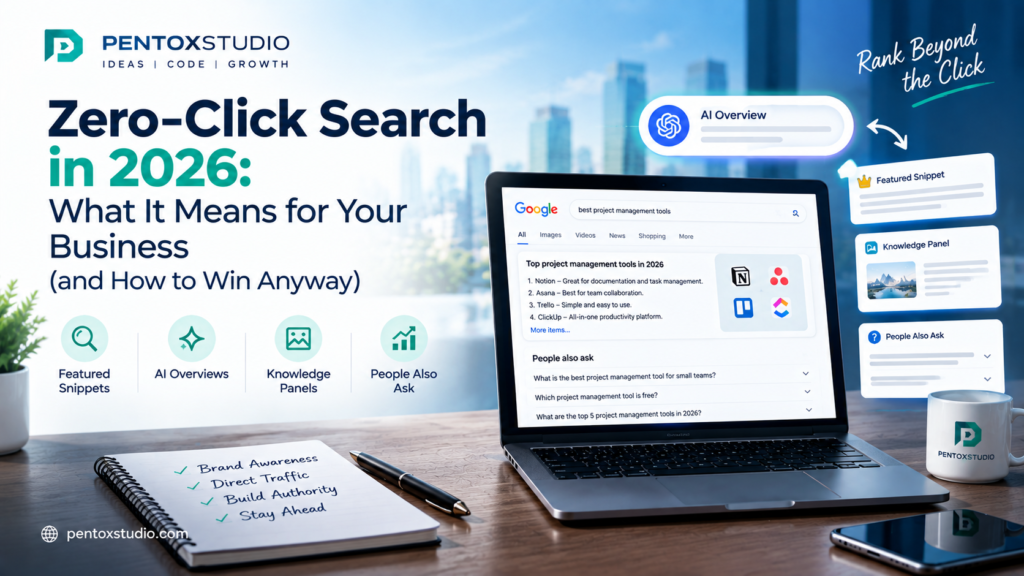
Zero-Click Search in 2026: What It Means for Your Business (and How to Win Anyway)
If your rankings look fine but your traffic doesn’t, you’re experiencing something with an actual name: zero-click search. It’s not a glitch, and it’s not just you. It’s a structural shift in how Google’s results page works, and it’s accelerating in 2026 as AI Overviews, live news carousels, and AI-generated answers take up more space above the traditional results.
This guide explains what zero-click search actually means, what the current data really shows including where different reports disagree, and, more importantly, a practical, business-focused plan for staying visible and generating leads even as fewer searches end in a click. Pentox Studio works with businesses navigating exactly this shift across multiple markets, and where it’s useful, we’ll reference that experience directly.
What Is Zero-Click Search, Exactly?
| Image Title | Zero-Click Search Illustration |
| Placement | Directly under this H2 |
| AI Prompt | Flat vector illustration of a search results page where the answer appears directly at the top in a highlighted box, with the traditional list of links fading into the background, teal and navy palette, minimal clean style, no text, no logos. |
| ALT Text | Illustration of a search results page showing a direct answer box above faded traditional search results |
| Caption | The search is completed, the question is answered, and no website ever gets the visit. |
A zero-click search is any search where the user gets what they need directly on the results page, through a featured snippet, a knowledge panel, or increasingly an AI-generated summary, without clicking through to any website at all. This isn’t new, since featured snippets have caused zero-click searches for years, but the scale has changed dramatically as AI Overviews and similar features now appear across a much broader range of queries than snippets ever did.
The Data, Honestly Presented
Different reports currently show different numbers, and it’s worth being direct about that rather than picking whichever figure sounds most dramatic. SparkToro’s analysis reportedly shows a majority of US Google searches now ending without any click. A separate analysis from Numinix put zero-click searches specifically to the open web at around 27.6 percent, a smaller but still meaningful share, likely reflecting a different measurement approach, since their figure may exclude clicks that stay within Google’s own properties like Maps or YouTube, which SparkToro’s broader definition would include. The methodologies differ enough that neither number should be treated as the single real figure, but both point in the same direction: a rising share of searches complete without a website visit.
Why Zero-Click Search Is Accelerating Right Now
This isn’t a slow, abstract trend. Google has shipped several concrete changes to its results page recently that directly expand zero-click behavior:
-
- AI Overviews gaining a live news carousel and AI-generated images, giving the AI answer box more visual real estate and more query types it covers
-
- New citation displays inside AI Overviews, changing how, and whether, a source gets visible credit even when it’s used
-
- Google testing Web Guide, an experimental feature organizing results into AI-curated topic groups rather than the traditional ten blue links
-
- Search Console gaining new tools specifically for managing how content appears inside AI features, a tacit admission from Google that this is now standard infrastructure, not a temporary experiment
Separately, Bing has added its own AI visibility reporting covering intents, topics, and citation share to Bing Webmaster Tools, and OpenAI has begun integrating shopping partners directly into ChatGPT. The zero-click dynamic isn’t unique to Google. Every major search and AI platform is moving in the same direction simultaneously.
Is Zero-Click Search Actually Bad for Your Business?
| Image Title | Reframing Zero-Click Search Illustration |
| Placement | Directly under this H2 |
| AI Prompt | Flat vector illustration of a magnifying glass revealing a hidden silver lining pattern behind a declining line graph, teal and navy palette, minimal clean style, no text, no logos. |
| ALT Text | Illustration of a magnifying glass revealing a positive pattern behind a declining traffic graph |
| Caption | Fewer clicks doesn’t automatically mean less business, it depends entirely on what is replacing them. |
The honest answer is that it depends heavily on your business model and what kind of searches drive your traffic. Zero-click search is a genuine problem for businesses that monetize primarily through ad-supported content and pageviews. It is a more nuanced story for service and product businesses, where the click that matters most was never the purely informational one anyway.
Where Zero-Click Search Hurts Most
-
- Purely informational content such as what is and how does X work queries, since these are exactly what AI Overviews answer most completely, capturing the click that used to land on an explainer article
-
- Ad-revenue-dependent publishers, where traffic volume directly equals income regardless of what the visitor does next
Where It Matters Less Than the Headlines Suggest
-
- Commercial and transactional searches such as a service near me or hire a specific professional, which remain far more click-heavy, since AI systems are far less likely to complete an actual purchase or booking decision on someone’s behalf
-
- Businesses whose brand gets mentioned or cited inside an AI answer, since even without a click, brand exposure inside a trusted-feeling AI response can drive a direct, branded search shortly afterward
The practical takeaway is that if your business depends on ranking for broad informational content, this trend is a genuine threat requiring a real strategic response. If your business depends on commercial, local, or transactional searches, the picture is less dire, though not risk-free, and the fundamentals in this guide still apply.
What to Watch Going Forward
A few developments worth tracking without overstating certainty about any of them: measurement standards for AI citation and zero-click impact are still maturing, and the reporting frameworks that feel makeshift today will likely be replaced by more standardized tools within the next year or two. Regulatory pressure, like the UK’s Competition and Markets Authority order, could still meaningfully affect how much visibility Google is required to give publishers and advertisers into its ranking mechanics. Competitive dynamics between Google, Bing, and AI-native platforms like ChatGPT and Perplexity are still shifting fast enough that betting heavily on any single platform’s current behavior remains a genuinely risky strategy.
None of this uncertainty changes the practical response outlined in this guide. Technical health, genuine expertise, structured content, and honest measurement hold up regardless of exactly how these platform dynamics resolve, which is precisely why building them now is the safer bet.
The Old SEO Playbook vs. the Zero-Click Reality
| Old Assumption | 2026 Reality |
| Ranking #1 guarantees traffic | Ranking #1 for an informational query may still produce a zero-click result |
| Success equals organic traffic volume | Success increasingly means leads, branded search growth, and AI citation, not just clicks |
| Content written to rank | Content written to be both ranked and confidently citable and extractable by AI systems |
| One SEO report covers everything | Reporting needs to include AI Overview visibility and citation tracking alongside traditional rankings |
| Backlinks are the main authority signal | Brand mentions without links increasingly matter alongside traditional backlinks |
A Practical Action Plan for the Zero-Click Era
| Image Title | Zero-Click Action Plan Illustration |
| Placement | Directly under this H2 |
| AI Prompt | Flat vector illustration of a five-step roadmap with icons for a magnifying glass, a document, a megaphone, a chart, and a checkmark, teal and navy palette, clean minimal style, no text, no logos. |
| ALT Text | Illustration of a five-step action plan roadmap for adapting to zero-click search |
| Caption | A deliberate response beats hoping the trend reverses. |
-
- Audit which of your pages are purely informational versus commercial or transactional, and prioritize your response accordingly, since the commercial pages need less urgent change
-
- Restructure key informational content for AI extractability with direct answers under clear headings, short paragraphs, and specific facts, the same techniques that help win featured snippets and AI citations together
-
- Add schema markup sitewide, prioritizing your most commercially important and most-visited informational pages first
-
- Build genuine brand mention and digital PR activity, since unlinked citations increasingly feed AI trust signals the way backlinks fed traditional rankings
-
- Shift your success metrics to include branded search volume and AI citation tracking, not just organic click volume alone
-
- Double down on local and commercial content specifically, since this is where zero-click search currently does the least damage to real business outcomes
How to Measure Success When Clicks Decline
If organic click volume is your only success metric in 2026, you are measuring an incomplete picture. A more accurate scorecard includes the following:
-
- Branded search volume, since rising direct searches for your business name are a strong signal that AI-mediated exposure is working, even without a click
-
- AI citation tracking, meaning manually testing your core topics across ChatGPT, Gemini, and AI Overviews on a regular schedule and logging whether and how you are mentioned
-
- Leads and conversions from the traffic you do get, since a smaller but more qualified click volume can still produce equal or better business results
-
- Local pack and Google Business Profile visibility specifically, since this surface remains highly click-and-action-oriented even as broader informational search shifts
Illustrative Case Study: Two Content Strategies, Two Outcomes
| Image Title | Content Strategy Outcomes Illustration |
| Placement | Directly under this H2 |
| AI Prompt | Flat vector illustration of two diverging graph lines, one flat and one rising, both starting from the same point, teal and navy palette, minimal clean style, no text, no logos. |
| ALT Text | Illustration of two diverging outcome graphs representing different content strategy responses to zero-click search |
| Caption | The businesses treating this as a strategic shift, not a crisis to panic over, are the ones adapting fastest. |
To make this concrete, here is an illustrative, not client-specific, comparison of two consulting firms responding differently to the same traffic decline. Firm A noticed a decline in organic clicks to its informational blog content and responded by publishing more of the same kind of generic, broad-topic articles, hoping additional volume would offset the decline. Firm B took a different approach, auditing which specific pages were losing clicks, restructuring the highest-value ones for direct, extractable answers with schema markup added, and shifting its own internal reporting to track branded search volume and AI citation alongside traditional rankings.
Within a few months, Firm A’s total traffic continued declining alongside a growing pile of thin, similar content. Firm B saw traditional organic clicks continue a modest decline on purely informational pages, but branded search volume rose noticeably, and manual AI citation checks showed the firm being mentioned directly in response to several of its core topic areas, a pattern that in practice tends to correlate with new inquiries citing having seen the firm recommended by an AI tool.
Common Mistakes Businesses Make Responding to Zero-Click Search
-
- Panicking and assuming SEO no longer works at all, rather than recognizing the shift is uneven across query types
-
- Publishing more thin, generic content in response to declining clicks, compounding the underlying problem rather than solving it
-
- Measuring success purely by click volume, missing the branded search and citation signals that increasingly indicate real impact
-
- Ignoring schema markup and structured data, which have become more directly valuable as AI systems parse content at scale
-
- Assuming the trend is uniform across all query types, when commercial and local searches are affected far less than broad informational ones
Expert Tips
-
- Segment your own analytics by query type before drawing conclusions, since a blended, sitewide traffic number hides which pages are actually affected
-
- Track branded search growth in Search Console specifically as a proxy for AI-driven exposure that doesn’t show up as a click
-
- Don’t abandon informational content entirely, since it still builds topical authority and citation eligibility even when the click itself declines
-
- Revisit old, previously high-traffic informational pages specifically, since these are often the ones losing the most to AI Overviews and most worth restructuring first
Business Examples: How Different Businesses Should Respond
Example: A Content-Heavy Publisher
A media or blog-driven business monetizing through ad impressions faces the most direct threat from zero-click search, and would typically need to diversify toward newsletter subscriptions, community building, or direct product offerings less dependent on raw pageview volume.
Example: A Local Service Business
A local service business such as a plumber, dentist, or contractor is comparatively insulated, since these searches remain highly commercial and click-heavy. The priority here is making sure Google Business Profile and local SEO fundamentals stay strong rather than over-reacting to zero-click headlines.
Example: A B2B Consultancy
A B2B consultancy publishing educational content sits in the middle. The top-of-funnel blog traffic may decline, but restructuring that same content for AI citation can turn a lost click into a mentioned recommendation, which for a considered B2B purchase can still influence a buying decision even without a direct visit.
How Pentox Studio Approaches Zero-Click Search With Clients
Rather than treating this as a reason to panic or abandon content strategy altogether, Pentox Studio segments a client’s content and query types first, applies the structural and schema changes that help with AI citation where the informational content genuinely needs it, and expands reporting to include branded search and citation tracking alongside traditional metrics, so clients get an honest, complete picture rather than an incomplete one built around a declining click count alone.
Checklist: Is Your Business Zero-Click-Ready?
-
- You’ve segmented your analytics by informational versus commercial or transactional query types
-
- Your highest-value informational pages are structured with direct answers and clear headings
-
- Schema markup is implemented on your most important pages
-
- You track branded search volume as a distinct success metric
-
- You periodically test your core topics manually across ChatGPT, Gemini, and AI Overviews
-
- Your Google Business Profile and local SEO fundamentals are fully optimized, since this surface remains click-heavy
-
- You are building genuine brand mentions and digital PR, not just traditional backlinks
Frequently Asked Questions
1. What is zero-click search?
A zero-click search is any search where the user gets what they need directly on the results page, through a featured snippet, knowledge panel, or AI-generated summary, without clicking through to any website.
2. What percentage of Google searches are zero-click?
Estimates vary by source and methodology. SparkToro’s data reportedly shows a majority of US searches ending without a click, while a separate Numinix analysis put zero-click searches to the open web at roughly 27.6 percent. Both point to a significant and rising share.
3. Is zero-click search bad for SEO?
It changes what SEO needs to accomplish rather than making it pointless. Purely informational content is affected most, while commercial and local searches remain comparatively click-heavy.
4. Is SEO dead because of zero-click search and AI Overviews?
No. SEO fundamentals, including technical health, content quality, and authority, still underpin both traditional rankings and AI citation. The goal has broadened rather than disappeared.
5. How do I know if zero-click search is affecting my business?
Segment your analytics by query type. A decline concentrated in informational content, alongside stable or growing branded search, is a strong sign of zero-click impact rather than a broader ranking problem.
6. What should I do if my organic traffic is declining?
First confirm whether the decline is concentrated in informational content specifically, then restructure that content for AI extractability and add schema markup before assuming a ranking penalty is to blame.
7. Does zero-click search affect local businesses as much as content publishers?
No, considerably less. Local and commercial searches remain far more click-and-action-oriented, since AI systems are unlikely to complete a booking or purchase decision on someone’s behalf.
8. What is a knowledge panel?
An information box, typically on the right side of Google results, summarizing key facts about an entity such as a business, person, or topic directly on the results page.
9. How do I track AI citation if there’s no click involved?
Manually test your core topics across ChatGPT, Gemini, and Google AI Overviews on a regular schedule, logging whether and how your business is mentioned, since automated tracking tools are still maturing.
10. What is branded search, and why does it matter here?
Branded search is when someone searches directly for your business name. Rising branded search often indicates people encountered your brand via an AI answer and searched for you afterward, even though that AI interaction itself produced no click.
11. Should I stop publishing informational content because of zero-click search?
No. Informational content still builds topical authority and citation eligibility, so the response should be restructuring it for extractability, not abandoning it.
12. What is Google’s Web Guide feature?
An experimental Google feature organizing search results into AI-curated topic groups rather than the traditional ten blue links, reflecting Google’s broader shift toward AI-structured results pages.
13. How does schema markup help with zero-click search specifically?
It gives search engines and AI systems explicit, structured information about your content, increasing the likelihood of accurate representation in features like knowledge panels and AI Overviews.
14. What industries are least affected by zero-click search?
Highly local, transactional, and urgent-need service industries, since these searches convert to real-world action that Google and AI systems are unlikely to fully replace.
15. Are backlinks still important given zero-click search and AI citation?
Yes, backlinks remain important for traditional rankings, and increasingly, unlinked brand mentions add a complementary trust signal for AI citation specifically.
16. How has the UK’s regulatory action against Google affected this trend?
The UK Competition and Markets Authority ordering Google to disclose more about search ranking mechanics and support data portability adds regulatory pressure, though it hasn’t reversed the underlying product shift toward AI-driven results.
17. Should I change how I report SEO results to stakeholders?
Yes, reporting should expand to include branded search volume and AI citation tracking alongside traditional click and ranking metrics, giving a more complete picture of real impact.
18. Can paid advertising help offset zero-click search’s impact on organic traffic?
It can help diversify traffic sources, though paid ads face some of the same AI-driven results-page competition, making a diversified strategy across SEO, AI visibility, and paid channels the safer approach.
19. Will zero-click search continue increasing?
Current product changes from Google, Bing, and OpenAI all point toward continued growth in AI-mediated, zero-click experiences, though the pace and ultimate ceiling remain genuinely uncertain.
20. How does Pentox Studio help businesses adapt to zero-click search?
By segmenting content and query types, applying targeted structural and schema changes where genuinely needed, and expanding reporting to include branded search and AI citation alongside traditional metrics.
Conclusion: Adapt the Strategy, Don’t Abandon It
Zero-click search is a real, accelerating shift, not a myth or a reason to panic. The businesses navigating it well are not the ones abandoning SEO or content, they are the ones being honest about which parts of their strategy the shift actually affects, adapting their content structure and reporting accordingly, and continuing to invest in the fundamentals, technical health, genuine expertise, and structured content, that matter across every version of search, clicked or not.
The click was never actually the goal. It was always a proxy for the thing that mattered: someone finding your business trustworthy enough to choose. That is still entirely achievable in a zero-click world, it just requires measuring and building for it deliberately.
Want a clear picture of how zero-click search is actually affecting your specific traffic? Request a free AI search visibility audit from Pentox Studio. We’ll show you exactly where your traffic stands and what’s genuinely worth changing.
Learn more about Google’s official SEO guidelines on Google Search Central.
Monitor your website performance using Google Search Console.
Track your traffic with Google Analytics.
Improve your Core Web Vitals using Google PageSpeed Insights.
Implement structured data using Schema.org.
Optimize your Bing presence with Microsoft Bing Webmaster Tools.